Thursday, September 15, 2016

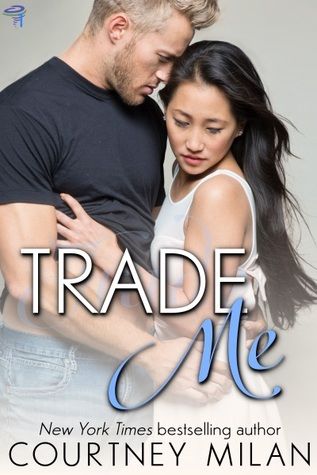
Trade Me by Courtney Milan

Title: Trade Me (Cyclone #1)
Author: Courtney Milan
Publisher: Courtney Milan
Publication date:  January 19, 2015
Rating: ★★★★

Summary (via Goodreads):

Tina Chen just wants a degree and a job, so her parents never have to worry about making rent again. She has no time for Blake Reynolds, the sexy billionaire who stands to inherit Cyclone Technology. But when he makes an off-hand comment about what it means to be poor, she loses her cool and tells him he couldn’t last a month living her life.

To her shock, Blake offers her a trade: She’ll get his income, his house, his car. In exchange, he’ll work her hours and send money home to her family. No expectations; no future obligations.

But before long, they’re trading not just lives, but secrets, kisses, and heated nights together. No expectations might break Tina’s heart...but Blake’s secrets could ruin her life.
I have NO appropriate words to describe how much I loved this book, even with its lackluster resolution. Every time I think about Blake and/or Tina, I just want to puke in enthusiasm.

I mean, an Asian female MC in a new adult book?

An Asian female MC in a new adult book who is actually bright, and driven, and sex-positive, and proud of her family, and not fetishized, and compassionate, and socially aware? A character that I can actually relate to??!?

Pinch me. I must be dreaming.

Tina Chen is the main reason I picked up this book. I needed to read a new adult novel that was not all about white people. And you know what? She struck a deep chord with me.

I always, always love a female MC who shies away from love and commitment. I love a girl who thinks relationships are dangerous, who believes in protecting herself (and her family) first. I AM THAT GIRL. And Tina is that girl. She has to grapple with safety and risk, and contend with her interest in the perfect-by-traditional-Western-standards Blake Reynolds.

Blake is fascinating. He's imperfect and flawed in ways that matter. Despite his ignorance and privileged upbringing, he respects people. He makes mistakes but he learns and tries to do better – he is everything I wish the people of the Internet would be. (Ahem.)

Tina and Blake are compelling on their own, but when they're together, it's impossible to drag your eyes away. Their dynamic is so interesting – the back and forth, give and take. They make each other feel understood. They make each other feel good. They call it like it is. They speak openly. They don't play games. It's so goddamn refreshing to see two intelligent adults acting like intelligent adults in a relationship. How annoying is it when the key conflict in a story could be resolved by a couple actually communicating with each other? There's none of that nonsense here. The conflicts and challenges they face actually matter; they're complicated. There's no easy way out.

Blake is a complex person with a complex relationship with his father; for better or for worse, it colors his life and the decisions he makes, and it is because of this that the "issues" in this book don't feel like "issues." The problems and solutions, as Blake says, are "all tangled up, knitted together so firmly that you can't excise the problem without blowing the solution to bits." Courtney Milan has certainly knitted together a story where that's the case, though I do wish the "solution" had been somewhat less anti-climactic. The end came together rather quickly and rather too conveniently – before I knew it, the story was over. I wish we had gotten to see a little more romance between Tina and Blake. Softer, slower moments. A little more lingering instead of a constant rush forward.

Maybe because of the way it was written – with scenes that propelled the story forward – I read this book in 5 hours. I devoured it. And on my commute to work this morning, I started reading it again. To savor it. To revisit and reconsider my thoughts on relationships. To bask in the existence of a well-written Chinese female character. A well-written Chinese female character, written well by a non-Chinese author. (I mean, whaaaa???? Side-eye emoji. Side-eye emoji. Side-eye emoji.)

This is the part where I don't really know what else to say. Trade Me made me laugh. It made me cry. It made me feel like I was learning something. It was a really smart book. It made me feel seen. It made me have some degree of faith in humanity. (No joke.)

Read this book if you're tired of never seeing yourself in books.
Read this book if you want to see relationships based on mutual respect.
Read this book if you like your parents.
Read this book if you don't.

Read this book if you think stories should mean something. Because this one does.

Wednesday, August 31, 2016

Cloudwish by Fiona Wood

Title: Cloudwish
Author: Fiona Wood
Publisher: Poppy
Publication date: October 18, 2016
Rating: ★★★★½

Summary (via Goodreads):

For Vân Uoc, fantasies fall into two categories: nourishing or pointless. Daydreaming about attending her own art opening? Nourishing. Daydreaming about Billy Gardiner, star of the rowing team who doesn't even know she's alive? Pointless.

So Vân Uoc tries to stick to her reality--keeping a low profile as a scholarship student at her prestigious Melbourne private school, managing her mother's PTSD from a traumatic emigration from Vietnam, and admiring Billy from afar. Until she makes a wish that inexplicably--possibly magically--comes true. Billy actually notices her. In fact, he seems to genuinely like her. But as they try to fit each other into their very different lives, Vân Uoc can't help but wonder why Billy has suddenly fallen for her. Is it the magic of first love, or is it magic from a well-timed wish that will eventually, inevitably, come to an end?

A million thanks to the publisher for sending me an advance copy. Cloudwish hooked me from the very beginning and did not disappoint.

While the story itself is compelling (give me the "girl and boy come from two different worlds and fall in love?" trope any day of the week... especially if mixed class or mixed race relationships are involved), I was most notably blown away by how personal it felt and how deeply I could relate to Vân Ûóc and her thoughts and feelings and experiences.

Let me be very clear: Vân Ǔóc and I come from two different backgrounds. I am Taiwanese-American with parents who immigrated to America out of their own free will. They went to college in Taiwan and were able to pursue further education when they moved to the States. They had NOTHING when they came here but they were not refugees by any means. In spite of our differences, I still understood Ván Ûóc as though I were reading my own diary.

Having grown up in a suburb filled with affluent white kids, I know the feeling of being an "other." I understand the social navigation, the responsibilities, trying to measure up and fit in, trying to keep school and home separate, the shame of being part of a different culture, and the guilt that comes from feeling ashamed at all...

But I also know what it's like to balance all of that with dreams. And expectations. I was the English-loving STEM student who spent her lunch hour in the art room working on mixed media pieces or in my sketchbook and tutoring kids who needed physics help after school. The premise behind my AP Studio Art portfolio? Head vs. heart. Home. Belonging. Choices. I applied to college as an engineering major. (And eventually transferred into the humanities.)

So I get it.

How refreshing to see a fragment of my own experiences reflected back at me. (How silly that such a small thing feels "refreshing"—for white readers, this is just a given.) But Ván Ûóc is smart and thoughtful and proud and insecure and observant and dedicated and driven and creative and reflective and funny and socially conscious and politically aware and practical and daydreamy and weird and a typical teenage girl and also not a typical teenage girl at all. She reminds me of myself at age 17. Kindred spirits. I can't help but think that if I had read this book back then, I would have been all the better for it. I could have learned a lot from a girl like Ván Ûóc when I was 17.

But back to the book itself. The story was charming, and the characters delightful and sincere and real. (I'm so glad Michael showed up again. He was my favorite in Wildlife, so I was pleased to see him still doing his thing. I also liked Billy Gardiner—he's kind of a lovable idiot who is courteous and means well and is very polite to parents but is self-assured and arrogant and maybe a little offensive and ignorant because he was born and raised privileged. He reminded me of some of the boys I knew in high school, whom I looked at in very much the same way that Ván Ûóc looks at Billy.)

The relationships are complex and varied—there's friends and then there's school friends, and first love, of course... But you also have a mother/daughter relationship that is riddled with the complexity of culture "clash" and additional baggage, and it makes the interactions feel that much more poignant and sweeping. And the writing was rich and clever—what a voice. It carried me through the pages and left me satisfied but also still wishing I could stay just a little longer.

Books that feature POC characters and are written by white authors can often go awry, but I thought this was done incredibly well. To me it really feels like the author did her due diligence in researching and speaking with many actual Vietnamese people—in other words, letting Ván Ûóc speak her story without it being muffled or slanted by white preconceptions. Does the story rely on certain stereotypes? Sure. But those stereotypes exist and are still relevant today, so I'm happy to see those stereotypes (and their effects/influences) as an important aspect—but not the main focus—of this story.

Anyway. This review has turned into one massive blog entry so I'll sign off here and just leave you with this: Cloudwish is easily my favorite Fiona Wood book by far. I feel blown away and want to flip back to the very beginning and reread it all again right away.

Tuesday, June 7, 2016

Review / Truthwitch by Susan Dennard

Title: Truthwitch (The Witchlands #1)
Author: Susan Dennard
Publisher: Tor Teen
Publication date: January 5, 2016
Rating: ★★★★

Summary (via Goodreads):

On a continent ruled by three empires, some are born with a “witchery”, a magical skill that sets them apart from others.

In the Witchlands, there are almost as many types of magic as there are ways to get in trouble – as two desperate young women know all too well.

Safiya is a Truthwitch, able to discern truth from lie. It’s a powerful magic that many would kill to have on their side, especially amongst the nobility to which Safi was born. So Safi must keep her gift hidden, lest she be used as a pawn in the struggle between empires.

Iseult, a Threadwitch, can see the invisible ties that bind and entangle the lives around her—but she cannot see the bonds that touch her own heart. Her unlikely friendship with Safi has taken her from life as an outcast into one of reckless adventure, where she is a cool, wary balance to Safi’s hotheaded impulsiveness.

Safi and Iseult just want to be free to live their own lives, but war is coming to the Witchlands. With the help of the cunning Prince Merik (a Windwitch and ship’s captain) and the hindrance of a Bloodwitch bent on revenge, the friends must fight emperors, princes, and mercenaries alike, who will stop at nothing to get their hands on a Truthwitch.

A list of things I loved about Truthwitch:

1: Safi and Iseult's BFFship. Totally heartfelt and inspiring and honestly not forced or cheesy at all. They have their own lives, they hustle, but they depend on each other and they take care of each other and they prioritize each other's needs before their own. It's awesome, and it makes me want to find a like-minded assassin/thief BFF to Netflix and chill with on the weekends.

2: The characters, who are all even better than I could have imagined. Every single one of them.

2a: Uncle Eron, Safi's perpetually drunk uncle. He doesn't feature that heavily in this book, but goddamn if he doesn't make your head spin.

2b: Iseult. She is so easy for me to relate to (I love her "aloofness" and I really understand the struggle between feeling too much and not feeling enough). She's probably the second most compelling character to me, the first being...

2c: Aeduan – what a cranky snarl ball! All throughout her promotional interviews and tours, Susan Dennard kept emphasizing that Aeduan may or may not be a villain, and I kept thinking to myself, "Yeah, yeah, he's bad on the outside but good on the inside (#MorallyComplicatedYA)." I was convinced he'd start off as a terrible person, but turn into a dark Prince Charming halfway through the book. Easy peasy. But no – Susan Dennard has some tricks up her sleeve. Aeduan is such an interesting character – so similar to Iseult in that he's learned to distance himself from his emotions – with an even more interesting background that I'm excited to explore over the course of the next few books.

2d: Kullen! I have a crush on Kullen! I want a novella about him and Ryber!

2e: Merik! I did not think I was going to fall for Merik. I'm not usually a sucker for the handsome prince with washboard abs, but everything changed with these four words: "Your loss, I promise." (!!!) I reread that sentence, like, FIFTY TIMES and blushed for the rest of the day.

3: Being able to jump from one character's perspective to another. Variety is the spice of life, and it's really fun to be able to hop around from location to location and experience so many different things in this huge, wonderful world.

4: The moments when characters start to fall in love. There are so many magical scenes littered throughout the book that really shine. Such a treat to read.

5: The action. Listen – I'm not the biggest fan of action-adventure stories because (a) I'm a crybaby scaredy-cat and (b) I'm more of a sucker for stories with lots of navel-gazing, sadness, and angst. But the action in Truthwitch is fantastic. It's what propels the story forward. It's compelling and exciting, and it's impossible not to turn the page.

With all that being said, there are two things keeping me from liking Truthwitch more. The writing is awkward at times – it feels a little bit too conversational, almost like the author is sitting next to me, telling me the story, rather than me reading and being fully immersed in it. But that's totally a personal preference – I'm sure others will see this and have NO clue what I'm talking about.

The pacing is the other thing that bothered me about this book. The story starts out with a bang – you're thrown into this world that is huge and complicated, and it takes a while before you really understand what's going on. And then the story slows down a lot. In the first half, you're mostly getting grounded in the historical and political context of the Witchlands, while the second half is where the story really gets off the ground. It's a bit of a slog, and I do wish that those details had been explained more efficiently... but hopefully that just means that once Book 2, Windwitch, is published, we'll be familiar with the context already and it will be smooth sailing from there. (Get it? Because he's a sailor/ship captain? Right? *slinks away*)

Wednesday, May 25, 2016

Eleven Hours by Pamela Erens

Title: Eleven Hours
Author: Pamela Erens
Publisher: Tin House
Publication date: May 2, 2016
Rating: ★★★★

Summary (via Goodreads):
Lore arrives at the hospital alone—no husband, no partner, no friends. Her birth plan is explicit: she wants no fetal monitor, no IV, no epidural. Franckline, a nurse in the maternity ward—herself on the verge of showing—is patient with the young woman. She knows what it’s like to worry that something might go wrong, and she understands the pain when it does. She knows as well as anyone the severe challenge of childbirth, what it does to the mind and the body.

Eleven Hours is the story of two soon-to-be mothers who, in the midst of a difficult labor, are forced to reckon with their pasts and re-create their futures. Lore must disentangle herself from a love triangle; Franckline must move beyond past traumas to accept the life that’s waiting for her. Pamela Erens moves seamlessly between their begrudging friendship and the memories evoked by so intense an experience. At turns urgent and lyrical, Erens’s novel is a visceral portrait of childbirth, and a vivid rendering of the way we approach motherhood—with fear and joy, anguish and awe.

Many thanks to the publisher for sending me this electronic copy via NetGalley in exchange for my honest review.

This book is SO "literary." It feels like a grad school writing prompt gone wild. But in a good way. (Really, what else would you expect from a publisher like Tin House?)

I requested Eleven Hours on NetGalley because I recognized the author, Pamela Erens. (Someone had recommended her previous book, The Virgins, as a better (less racist? - my words, not theirs) version of Eleanor & Park.) I haven't yet read The Virgins, but suffice it to say I was interested in her work.

The story is told from a third person perspective, following two characters - Lore Tannenbaum and her midwife Franckline. For me, Lore is the more compelling of the two, so I will focus on her here.

At the onset, Lore is not the most likable character. She is demanding and cool - perhaps too outwardly emotionless and independent for her own good. It's not easy to empathize with her, and the story's slightly detached point of view doesn't make it any easier. As the book progresses, we find out more about her relationships and the emotional pain she has experienced - all of the things that have led her to where she is at that moment - and though it doesn't exactly make us like her any better, it feels like we slowly come to understand her.

On a personal level, I found myself fiercely rooting for her. I understood her - I understood her compulsion to push people away in order to protect herself. I understood her need for control. I understood her seemingly cold nature and unwillingness to let herself get attached. It was fascinating to experience her journey through pregnancy, as well as her shifting attitudes toward this child that she carried.

My investment in Lore's wellbeing surprised even myself - I am not one for books about motherhood. I can barely stomach mommy blogs. A story about a woman giving birth? The miracle of life? Ummm. Thanks but no thanks. And yet I found Eleven Hours to be a surprisingly gripping read - there's just enough suspense to keep you turning the pages. For those of you who think books about birth are boring, THINK AGAIN. Birth is freaking terrifying and gory. It's like voluntarily turning your life into a horror film. Women are badass.

But I digress.

The book goes back and forth between past and present, shifting from a focus on Lore's life to Franckline's. The story seems to wander leisurely, the tension slowly building as Lore gets closer and closer to birth.

The writing really is something. Ideas are expressed so articulately - you'll read something and think, "Yes, exactly. That's exactly what it feels like." In some ways, I feel the writing is much stronger than the story. And in fact, Eleven Hours feels like less of a "story" and more like an exercise in empathy - it's like the author wanted to take a not-particularly-likable character and make the reader want to fight for her by the end of the story, whether or not you've experienced motherhood or pregnancy yourself. Whatever the intention, it worked for me. I am much more conscious and simultaneously in a state of awe and fear of pregnancy after reading this book. Lore Tannenbaum is certainly not someone I'll forget in a jiffy.

Sunday, May 15, 2016

Fever at Dawn by Péter Gárdos

Title: Fever at Dawn
Author: Péter Gárdos, Elizabeth Szász (translation)
Publisher: Anansi International
Publication date: April 30, 2016
Rating: ★★★

Summary (via Goodreads):

Twenty-five-year-old Holocaust survivor Miklós is being shipped from the Bergen-Belsen concentration camp to Gotland, Sweden, to receive treatment at the Larbro Hospital. Here he is sentenced to death again: he is diagnosed with tuberculosis and his doctors inform him that he has six months to live. But Miklós decides to wage war on his own fate: he writes 117 letters to 117 Hungarian girls, all of whom are being treated in the Swedish camps, with the aim of eventually choosing a wife from among them.

Two hundred kilometres away, in another Swedish rehabilitation camp, nineteen-year-old Lili receives Miklós’s letter. Since she is bedridden for three weeks due to a serious kidney problem, out of boredom — and curiosity — she decides to write back.

The slightly formal exchange of letters becomes increasingly intimate. When the two finally manage to meet, they fall in love and are determined to marry, despite the odds that are against them.

Based on the original letters written by Miklós and Lili (ninety-six altogether), Fever at Dawn is a tale of passion, striving, and betrayal; true and false friendships; doubt and faith; and the redeeming power of love.

Many thanks to the publisher for sending me this electronic copy via NetGalley in exchange for my honest review.

The synopsis of Fever at Dawn is far more compelling than the book itself. My problem is this: the storyline meanders on and on, with far too many loose ends left behind. By the time you reach the end of the book, you're left wondering why you even bothered to read the thing you just read.

Fever at Dawn is based on the real life story of the Jewish-Hungarian author/director Péter Gárdos's parents, which perhaps makes the story more interesting than it would be otherwise, but it also makes me wonder if the author just took bits and pieces of real life, added in a weak backstory, and called it a day. There were moments that stood out to me, but there was not enough "plot" or momentum to really hold everything together. In some ways, it felt like I was reading a fictionalized account of someone's daily journal - some things were interesting, but on the whole, it was missing a roadmap. If you were to ask me, I don't think I could even tell you what the real point of the story was - the plot structure was unclear and really lacking.

Like I said, the description of Fever at Dawn oversells the book for me - the themes mentioned (betrayal, friendship, striving, love...) are all there, but they feel like afterthoughts - somehow disjointed from the essence of the story. But I do have to say that the writing is lovely and well-translated by Eliabeth Szász. The characters are also interesting - particularly Miklós, the optimistic and quirky and ever-hopeful protagonist. I only wish the storyline itself had been more carefully thought through.

Sunday, April 24, 2016

Me Before You by Jojo Moyes

Title: Me Before You (Me Before You #1)
Author: Jojo Moyes
Publisher: Pamela Dorman Books/Viking
Publication date: December 31, 2012
Rating: ★★★★★

Summary (via Goodreads):

Lou Clark knows lots of things. She knows how many footsteps there are between the bus stop and home. She knows she likes working in The Buttered Bun tea shop and she knows she might not love her boyfriend Patrick.

What Lou doesn't know is she's about to lose her job or that knowing what's coming is what keeps her sane.

Will Traynor knows his motorcycle accident took away his desire to live. He knows everything feels very small and rather joyless now and he knows exactly how he's going to put a stop to that.

What Will doesn't know is that Lou is about to burst into his world in a riot of colour. And neither of them knows they're going to change the other for all time.

This was a great book. It was touching, poignant, funny, sad – all of that stuff you might expect from a book that brands itself as a "heartbreakingly romantic novel.” And maybe if I had read this at some other point in my life, I’d have more to say along those lines – but the fact of the matter, and what I’ve found to be true time and time again, is that what you get out of a book depends entirely on where you are in your life.

There are some moments in your life that you recognize as turning points. Whether it’s in your professional development, in your relationships, whether it’s emotionally. My work friend Anita lent me her copy of Me Before You just as I was standing on the cusp of the most devastating moments in my life so far… so it wasn’t hard to identify with this story. The love. The loss. Both of which can be seen on so many levels.

In some ways it is soothing to read all the things you’re feeling: this weird hysteria and the irrational urge to laugh. The inexplicable need to stop time. The feeling of not being able to. Wanting to disconnect and, at the same time, to wrap every fiber of your being around a moment, to keep it from escaping, to keep the memory from fading away. All of the things I felt while reading this book mirrored all of the things I felt while living my real life, and it was horrible, wretched, devastating, completely soul-shattering. And it was also somehow a salve… like a gentle touch on the back of your neck to remind you that it’s okay to feel the things you’re feeling. And that you’re not the only person who’s bathed in this ocean of grief before.

I’m keeping this book for myself and buying Anita a new copy because this copy that she’s lent me now has creases in the pages, drag marks, smudges and spots, that are important to me. They are physical reminders of things that happened that I want to keep close to me forever.

I really have nothing else to say so I'm going to leave you with a song that I listened to on my way home from the airport that I think fits the tone of the book. It also just resonates so deeply with me on a very personal level. I don't even know what the lyrics are, but it feels like a blanket and I had to try really hard to keep from bawling my eyes out right there on the bus.

Thursday, February 4, 2016

All the Light We Cannot See

Title: All the Light We Cannot See
Author: Anthony Doerr
Publisher: Scribner
Publication date: May 6, 2014
Rating: ★★★★★

Summary (via Goodreads):

Marie-Laure lives with her father in Paris near the Museum of Natural History, where he works as the master of its thousands of locks. When she is six, Marie-Laure goes blind and her father builds a perfect miniature of their neighborhood so she can memorize it by touch and navigate her way home. When she is twelve, the Nazis occupy Paris and father and daughter flee to the walled citadel of Saint-Malo, where Marie-Laure’s reclusive great-uncle lives in a tall house by the sea. With them they carry what might be the museum’s most valuable and dangerous jewel.

In a mining town in Germany, the orphan Werner grows up with his younger sister, enchanted by a crude radio they find. Werner becomes an expert at building and fixing these crucial new instruments, a talent that wins him a place at a brutal academy for Hitler Youth, then a special assignment to track the resistance. More and more aware of the human cost of his intelligence, Werner travels through the heart of the war and, finally, into Saint-Malo, where his story and Marie-Laure’s converge.

After I finished reading the most magnificent, beautiful, thrilling, dazzling, wonderful Pulitzer Prize-winning book called All the Light We Cannot See, it got me wondering about a lot of things that I can't seem to shake...

1. The way we pass judgment on people.


The way we decide if someone is "good" or "bad," and whether or not they are redeemable. The way we hold people accountable. How do we decide who the Von Rumpels and Claude Levittes of the world are? And the Werner Pfennigs and the Frank Volkheimers? How do we decide whose decisions are justified, whose motivations are strong enough to counterbalance all the bad that they create, whose backstories rationalize their actions & where they end up?

Anthony Doerr, the author of the book, paints Werner and Volkheimer in the most fascinating light. Werner, the small boy, instrumental to the German war effort, but still just a boy, one who buttons his coat all the way to the top and pulls his sleeves down over his fingers when it's cold. Volkheimer, the giant, the one all the boys look up to – who will shoot a man in the back of his head but whose entire expression changes when he listens to classical music.

Every so often there's something in the news about former Nazi supporters being found out and tried as war criminals. I bury myself in the comments as the debate rages on: Does justice even matter at this point? Should people be held accountable for what they did 60 years ago when they were young, impressionable teenagers? Can war crimes ever be forgiven? For some people, it's black and white. And for others, it's more complicated. I'm not sure what I believe, but I do know that within a single human being, there is the capacity to be both very good and very bad. And maybe certain things in our lives push us toward a proclivity for one or the other.

2. The reality of war & the impossibility of happy endings.


When people get taken to labor camps and prison camps, they probably won't come back. And yet, one still hopes... (Maybe I am an optimist after all.) I spend so much of my life hoping for miracles, for impossibilities, for torn apart families to find each other again, for there to be a switch that makes everything better. I'm not prepared for books that mix magical realism with reality, it messes with my brain.

3. The way we trivialize the past.


We're so careless with history, the people who have lived and died. Like they're just facts in a textbook, even though they changed lives. The self-immolating monk. Emmett Till. The Vietnam War. All of these things I learned in school, reduced to grainy pictures in a history book that I never read, that was filled with doodles from all the students of years past. Historic sites are filled with tourists who say cheese as they snap their selfies. Candy wrappers strewn about military forts where men and boys gave their lives. A Buddhist saying: Nothing is sacred.

4. Courage, manifested by everyday heroes.


"When I lost my sight, Werner, people said I was brave. When my father left, people said I was brave. But it is not bravery; I have no choice. I wake up and live my life. Don't you do the same?"

I don't know, I don't know. I just want to leave these few lines here and let them germinate because it seems so natural, live your life, do what must be done, but it's still so easy to bury your head in the sand and pretend like nothing's the matter. Marie-Laure kept her head up, but it took Werner longer, and maybe it takes other people such a long time as well – so how do we learn to live our lives like we have no choice, to do what must be done, even when we're scared? What are the stakes and how do we make them matter so that we don't let our days fall away?

5. The world, which spins on and on and on.


The Sea of Flames is a blue diamond that took eons to form and has existed for eons after. It has lived through dynasties, the rise and fall of empires, endless numbers of births, deaths, and continues to live through all of these things, even as people's entire worlds come to an end.

Bombings, a new state of emergency, viruses spread. Pop culture icons die, one right after another, in the span of seven days, and the world keeps spinning on. Just headlines on the news' front page. Tomorrow the headlines will change. Maybe there will be more bombings, maybe the viruses will continue to spread, but the tides still rise and fall, Earth still spins on its axis, stars explode and die out and it takes a thousand light-years for us to even notice.

I love these books that make me question my life and my world and my society and the way we move forward in time. It's like staring up into the sky at night, away from all the lights, and you're swallowed by the vast expanse of space and you feel both big and small, important and alive but just the owner of a life that will be lived and gone in the blink of an eye.

Tuesday, January 19, 2016

Review: Echo by Pam Muñoz Ryan

Title: Echo
Author: Pam Muñoz Ryan
Publisher: Scholastic Press
Publication date: February 24, 2015
Rating: ★★★★

Summary (via Goodreads):

Lost and alone in a forbidden forest, Otto meets three mysterious sisters and suddenly finds himself entwined in a puzzling quest involving a prophecy, a promise, and a harmonica.

Decades later, Friedrich in Germany, Mike in Pennsylvania, and Ivy in California each, in turn, become interwoven when the very same harmonica lands in their lives. All the children face daunting challenges: rescuing a father, protecting a brother, holding a family together. And ultimately, pulled by the invisible thread of destiny, their suspenseful solo stories converge in an orchestral crescendo.

Richly imagined and masterfully crafted, ECHO pushes the boundaries of genre and form, and shows us what is possible in how we tell stories. The result is an impassioned, uplifting, and virtuosic tour de force that will resound in your heart long after the last note has been struck.

Pam Muñoz Ryan was one of those authors I was lucky enough to discover at an early age. I happened to randomly pick up Esperanza Rising at a school book fair way back in 2000 and it immediately became one of my favorite books. I must have read it a dozen times, I loved it so much – so when I read an article a few months back that she had won the Kirkus Prize for Young Readers' Literature for her new book, Echo, and when I saw it at a bookstore a few weeks later, I knew I couldn't leave it behind.

Echo is a gorgeous book, from the way the cover and pages are designed, to the imagery and the way the setting is described (which, in my opinion, has always been one of the author's greatest strengths), to the magical storytelling – a fairytale that briefly follows the lives of three children living in three different "eras" in history: Hitler's Germany, the Great Depression, and post-WWII segregation in the United States. Broken into separate narratives, Friedrich, Mike, and Ivy's experiences are each filtered through an historical backdrop. The tension slowly builds and the stakes continue to rise until each of their tales reaches a climax... and then, strangely, it's like the book just fades to black.

This is my biggest gripe, and it's also why I think Echo feels a bit like a beautiful writing project – because it starts with a thread of an interesting concept (a prophecy and a harmonica), but it doesn't get developed in a gratifying way. The pacing is off. Pam Muñoz Ryan lays the foundation for an important chapter in each of these characters' lives, and at the most gripping moment, she cuts off the story. We find out what happens later on, but by then she's just telling us what we missed, a passive recap that feels like a letdown. At nearly 600 pages, this book is already quite hefty, but I actually wish the author had drawn out the story even more.

I'm not sure if it's because Echo is labeled as a middle grade book that the conflict resolution is lacking (I've had a similar observation with other MG books I've read – perhaps the more sordid bits are not deemed appropriate or relevant for younger readers?), but either way it's a shame. For me, this book could have been a five-star read if only the story felt more complete. Everything else is there – the subtle bits of magical realism that sweep you away, the characters that you can't help but root for, the diversity of their backgrounds and experiences, the beautiful writing, the story's overall brilliant premise, and the way everything comes full circle...

Normally, a gaping plot hole would make me dismiss a book entirely, but what makes me relent is the fact that, quite simply, this novel is about hope. It's about three young protagonists, and how a harmonica comes into their lives at exactly the right time, and how it connects them all, and how things happen for a reason. Synchronicity, you could say. So, to that end, I can somewhat come to terms with the author's decision to exclude the parts that she did... because the whole is more than just the sum of its parts, and in Echo, there's something much bigger at play.

Your fate is not yet sealed. Even in the darkest night, a star will shine, a bell will chime, a path will be revealed.

Thursday, January 7, 2016

Review: The Start of Me and You by Emery Lord

Title: The Start of Me and You
Author: Emery Lord
Publisher: Bloomsbury
Publication date: March 31, 2015
Rating: ★★★

Summary (via Goodreads):

Following her pitch-perfect debut Open Road Summer, Emery Lord pens another gorgeous story of best friends, new love, & second chances.

Brimming with heartfelt relationships and authentic high-school dynamics The Start of Me and You proves that it's never too late for second chances.

It's been a year since it happened—when Paige Hancock's first boyfriend died in an accident. After shutting out the world for two years, Paige is finally ready for a second chance at high school . . . and she has a plan. First: Get her old crush, Ryan Chase, to date her—the perfect way to convince everyone she's back to normal. Next: Join a club—simple, it's high school after all. But when Ryan's sweet, nerdy cousin, Max, moves to town and recruits Paige for the Quiz Bowl team (of all things!) her perfect plan is thrown for a serious loop. Will Paige be able to face her fears and finally open herself up to the life she was meant to live?

I'm sad to say that Emery Lord's books are perhaps just not for me.

I had heard great things about The Start of Me and You and was hoping I'd enjoy this one as much as others seem to have (or that I'd at least like it more than I did Open Road Summer) – but unfortunately I just thought it was really boring. The storyline was predictable and stale. It felt like every stereotypical teen flick – or the plot of every Sarah Dessen novel, minus pregnancy and jail time – rolled into one.

The characters never really came alive for me, either. I could visualize them all but I didn't connect with any of them or find them compelling enough to really feel invested in their lives. Even now I'm still forgetting the main character's name. (Is it Lucy? Sara? Megan? No. I just checked – it's Paige.)

All that being said, there are two things I really did like about The Start of Me and You. The first is Emery Lord's portrayal of a really strong, loyal group of friends – Tessa, Morgan, and Kayleigh, and eventually Ryan and Max. I didn't have friends like Paige's when I was in high school so I was happy to see (and fascinated by) that solidarity and support. And SLIGHTLY SPOILERY? BUT I was really glad she didn't throw in any unnecessary best friend drama with Tessa – no girl hate, no love triangle (not in the obvious, expected way, at least) – she kept this one thing pure and untainted, thank the (Emery) Lord.

The other thing I loved is the PostSecret scene toward the end of the book. Aside from the fact that I don't love name-dropping of contemporary works (it pulls me out of the story and back into real life – and she does this a lot throughout the book, calling out John Green, Gilmore Girls, Firefly, among others), I loved the way it made everything come together. It made the story feel a little tighter, less slapdash. And it was just a sweet, romantic moment. Special, in a way that the rest of the story wasn't.

The Start of Me and You is a light, easy read. I love contemporary novels but I don't usually go for light, easy reads so this is probably why it didn't gel with me – however, there are some passages and moments and lines in the book that are lovely to read and think about, so for that reason alone I'd say it's worth checking out.

For me, this book feels like the equivalent of eating ice cream on the boardwalk in the summer, or drinking pumpkin spice lattes and wearing chunky knit scarves in the fall: a little bit expected, but enjoyable enough.

Thursday, December 17, 2015

Illuminae: A Short Debriefing (Am I Not Merciful?)

.............................................................................
.'';':'''','';;',;';';::;;'';;'';;;;;';';:'';;;;;';;';'''';'';;;';;'';'';;;';
.';` ``''';:;;;;;;';';';'''';;;;;''''';';;'''';;'';';';;;;''';;;';';;':';';;;
.        `''''''''':;';''''''';'';';''';''';;;'''''''';;';'''';;;'''';';'''''
.;+'+::;'++'''+'''''''':';:;;';';'';''';;;';;';'''''';;;:;'+''''''';;';;:''';
.;'''';'';;,;:'';',;'';;';;';'''''';''';';'';;;';;'';';'';;'';;'';;'':;';';;'
.;;'''';'''''+;'':'';;'';''';;'''';;''';'';';'';''';';''''''';''''';;''';';';
.;';+#''''+'+''''';;''''''''+'''':'''':'';;'':';;';;;',';;;'';;:;';;''';'';';
.;::';;';'';:,;,,,;;:;'';'''';;';';''';;;;;;''''+++#+'++''+++''''';;;;'';'':'
.:''''';':'':;              . ;  ;`  .     ;`  ,     :   `    `   :   '';;;':
.';'+''+;+'@ @. #'+  ';;. '', `+ .`++ , ' ':,#''  ;: ::; :;+;;+`;;'   ;;;:;;;
.''.,                                      `            `              ';''':
.;'`  , .  ,;. :,:```, :` ,; `,:`   ' . `.,`.  ,.   ;   +.` ,: # ,,:::';;''';
.;;``:' ;` '++`;'+;`,+ `.'''  `++ `;+ ;.;:',  ,'::' :`  +'.:`+,  ;'';;''''';;
.;'                                                              `:';''':''''
.:;;:.`.`..,,,,,::;'+',,,.`,:';,:#+++;;;::::,:;''++###++;.,,:'',,.+;++'+';;''
.::;;;;;'```` ``````` ```                                               .;;;'
.::;+';'+..+#`+`.#,.`.+;,` ;:;,;;  ``.. ,,  :`; ;`  .;; ',';':, ; ``..:+ ';;'
.,::::::;`  ``  ` ```   ``                                     `  `   `` ;'';
.::::;:;;;,,;;,,```    `         `  `   `  ````      ``.:+###+,.```  ``:.';';
.,:::;:;'';'';+'+'''''+''++'''++':++'++;'''';+';'''';''':';;';''''''+;:'':'''
.,::;;:;++++++'';''''''''';'::';'';;;:;''''''':''''':'';,''';'';''''';;;;;::;
.,:;::::;''''';''';'''''';'';'':;''';''';'';;'';,:','',';'';''':;';'';'::';';
.,;'';:::';'';;'''''''''''+'+':''+';''''+':'+;''+:''';';';';'''''''':''''''':
.    `:::;;;'';'''''';'''''':'';';';';;:+'++';':;''':'':;'';';';'';''';'';'';
.   ..;:::;;;';:''';'''';:''';:';'''',''''';;''''''';'''+';'';''+;;;'';;'''';
.     ;:;::;;;:;'':''':;;'''''''';',;';:';'':;';:';''''':;';';,'''';''':;'':'
.  `..,''':;;::;';''';;''';+,;;''''':'''',+;''+,;:+,+:'+:'',:;:;''''',''',+;'
.    `:;''::;::;;;',':;'';;''':';;':'';:'''':,:''';;':'''';'';+::'''';'''''''
.    ` '''::::::;;'';,;;;::;;:;;;';';''';'':;,:':,:'',+;;';;;:;:':'''''';';':
.     '''':::,::;'''';';;;;:+:':,''',;'''::'''''++:';',''''';:':'';';';,;+';'
.    `,;'',:::::;'''':;';;:';;''';''';:';''';'';,:',';':;':';';;'';;;':''''''
.   ``:;''::::::;;''''':';;;';';:;;':;'':':,;:+'';:;''':',''';';;:'';',';;:''
.    `,::;,,:,:;;;;'';;;;;',':','':','';;';;;:,::;+;+;''';';'':;,;:''''':'+';
.::::::::',,,:::;;;';:::;:::;:;;',;;,':;''''''';:;';;;:::';'''':'''';'+;''';'
.::::;:;;';;';::;;;;::::;,;::;;:''';;:';':;;:;:;'::::'.'+''''';;;.::'''';':;;
.:,':'':;;';'';;::;';':;:;;,';;+:';:;'';+;;:';+;;;';;;;';';':+;''';'':'';'';'
.:.``   ````''+::;:::,.,.````````` ``.``,...:.,,;;;;';,;'''+'':+';'::'''':':'
..                                     `                                 .+''
.;   .    `.     ..     .` `.     .   .     .`    .   .      `.      ....  ''
.;,  @    '@     +@     #+ ,@    `@.  @+    @+    @+  @      @@      @@@@   :
.;:  @    '@     +@     #+ ,@    '@# .@@    @+    @@ `@     `@##     @'    `'
.,:  @    '@     +@     #+ ,@    #'@ @:@    @+    @'@ @     ;@ @     @@@@  ''
.:   @    '@     +@     #+ ,@    @`@`@ @    @+    @ @'@     @, @.    @'``  .;
.:   @ :  '@     '@     ## :@    @ '@@ @    @+    @  @@    `@@@@@    @'    ;'
.;`  @    '#@@   +@@'   .@@@;    @  @, @.   @+    @  '@    ##   @    @@@@  ';
.;   `    ````   ````    `:`     `  .` .`   ``    .   `    `   `.    ```. `''
.;                                                                        ,''
.:`                                                    `    ; ,           ;,'
.`;           :' :,`,   . `+ #@``,' :;.# ;    @, ` #, @    :  #            `'
. :            @ +',    ` ,+.,,@'@#.;.## @    @'`,`++,@    '`.@            `'
.;:            + `` `     `    ,      `. `    ,         ;;`             ` :;;
.;;       ````                           `   `                             '+
.;;::,::,:::,:,.::;:'''':;;';:,``.``````.,.:::,::..`` `              ;::.,'':
.::;:::::::::::,:::;;;:;;;';;:,.````````...,,::,::.........`,,,,,::::;;;;'';'
.::;:,:,::,::::;;::;;';;:;;;;::..````````.,,,,,::,::;:;.....,,,,,,::;;;;'''''
.,::,:::,::::,::;;;::::;;:;:,::...```.....,,:,,,::::;:::...,,::,,:::::;;'''''
.,:,,::,::,::::::;:;:;::::::,,`..````.....,,,,,:::::,:,:,,,,:::,,:::::;;'''''
.,:,:,:,,:,,,:,::::::::::::::````````..``,:::,,::::::::,::,,,::::::::::;;;;''
.:,::,,,:,,,,::::,,:::::::,:..```````,.`.::,:::::::::,,:::::::::,:::::::;;;;;
.` .. :,,,,,,,::,,:,,,,,,,,.......```...,,:::::::::,,,,::,;;::,::;::;:;;;:;''
. , : `,,,,,,,::,:::,:,.,,,,........``...:::::,:::,,,:,::,::,:,;;'''';;;;;;''
.  .,``.,,,,,,:,,,:,,,.``.,........,.``.,:,::::::::,::::,:::::,;''''''''';';'
. : .` ,.,,,,,:,,:,,,.`````````.........,::::,:::,,::,,::::,::;;;'';;''''';;'
.`;   .,,,,,.,,,,,,.``````..`..``..,,,.,,,:::,,::,::::,:::,:;:;:;;;:;''''';;'
. ` ,,,,,,,...,,,,.```.``.......``....,,,,:,,,,,::,,,,:,::::;:;'';;';;'';;';'
. :   `:,,,,..,,,..``....`.......```...,,,,,,:,,:,,,,,,,::::;:;'''';''';;;';;
. : :;:,,,,,..,,,````:....`......````..,,,:,,,:,,:::,,:.::,,:;;;''''''';;;';;
.`.   `:,,,..,,..````..,';;,`.`':;;``.::,''+:,,,;';,:,';:;'':;';;;;''''';;;';
.:....,:,,,,..,,.....``.....`.``..```..,,,,..,,,,,,,:,:,,::::;;;;;;'';'';;;;:
.:,,:,:,,,,,.`.......,:::,........```..,,,.,..,,:,,,,,,,,:::,:;;;;;;;;'';';::
.``.,,,,,,,,.`....................```.,,,,,,,,,,::,::,,,,::,:::;;;;';:;;'';::
.```,,,:::,,.............`...````.```.,,,,,,,.,::::::,,.,,,:::::;;;;;;;;;;;::
.``;,:,:,,:............`........`..``.,,,,,,,..::::,:,,:,,,:,::::;;;;::';;:::
. ,.,:,:,:,............`........`.```.,,,,,,,.,.:::,,,:::,,::::::;;;;;:;';:::
. , ,::::,,,...........`........`````.,,,:,,,:,,,::,::::,,::::::::;;;;;''':::
. , ,,:::,:,........,........```````..,::::::,,,,::::::::::::::;;,::;;;;;;:::
. ` ::::,:,........,,.,,.....```````...:::,:,,,,::::::::::::::::;,:::;;;;;,,:
. , `.:::::,,,.......,,,....````````...,,,:,,,,,,::,,:::::::::::::,,:;;:;::::
. :  `:::,,,,,,,............``````````.,:,,,,,,,.,:,,::::::;::;;;;::,::;;':::
.   `,,::,,,:,,,,...............```````.,,,,,,,.,::,:::::::;::::;;:::;;;'':::
. `,`:::,:,::,:,,:.............``````````,,,,,...:,,:::::::::::::;:::;;''::::
. `  ,,:::::,::,,,..............``````````.,.```,::::,:::::::::;;:::;''';::::
.  `,::::::,::::,,,.,.,..........```````````````.:,::::::::::,:;:,:;;;;;:::::
.,:,,::,,:::::::::.,,,,,.,..,.....``````````````.:::::::::::,:::,:::::;;:::::
.,,,,,:::,,,,:::::,.,,,.,.,,........````````````.,:,:::::,:,,;'';::;::;::::::
.:,,,.,::::,:,::::,,,.,,,,.,,,......```````````.,,.,::::::,,:;;;;:;::::::::::
.,,,,,:,,,,,,,::,,.,,,,,,.,,,,..,,...``````````..,,,::::::,::;;;::::::,,:,:::
.:,,:,,,::,,:,:,,,,,,,,,,,,,,,,,,,....`````````..,:,::::;;:::;;;::::::,,,:,::
.::,,,,,:,::,,::,,,,,,,,,,,,,,,,,,.....```````...,,,::::;;:,:::::,::::,,,,:::
.:,,,:,,:,,::,,,,,,,,,,,,,,,:,,,,,,,,,..``````...,,,,:::::,::::::::::,,,:::::
.::,,,,,:,,,,,:,,,,,,,,,,,,,,,:,:,,,,,,..`.```.,.,,,,:::::,,:,:::::,,,,,:::::
.,,:::,,,:,,,,,,,,:;':,:;'';':;,:,,,,,,..`.```.,,,,,,,,,::::,::::,,,,,,,,:::;
.::::,,,,,:,:,`                        `  `` ``.,,,,,,,,,:::;::,,,,,,,,,,:::;
.,::,:::,,:,,,    `  ` :        `. ;        .  `,,,.,,,,:,:::;:.,,,,,,,,,,:::
.:::,,::,::,:`  ; : `` '   ` `' ,;`' ,: .; `:   .,,...,,....,:..,,,,,,,,,,:::
....`::::::,:. ,  .`.` '     ,  :``     ,  ``   `````...........,,,,,,,,:::::
.  `,,:::::::,````........````  `````````` ``` ````...........,,,.,,,,,,,::::
.  `',:::::::,,,,,,:,,:::,:::::::,,,.,....`````.``............,,,,,,,,,,,,:::
.;::::::::::,,,,,,,,,,,,,,,:,:,:,,,,,....`````   ` ..,.........,.,,,,,,,,,:,:
.;:::;::;;:::,,,,,,,:,::,:::,::,,,,,,,...````` :,: ;.,,......,,,,,,,,,,,,,,::
.;;::::;;:;::,,,,,:,::,:,,,,:,,,,.,,,,..```````  ``.,,...,...,.,,,,,,:,,,,,::
.;:;;;;::;:::,,,,,,::,::,:,,,,,,,,.,.,.``````````.......,...,,,..,,,,,,,,,:,:
.';;;;;::'';:,:,,,,,,,,,::,,,:,,,,,,,,.````````.....,.....,.,.,,,,,,,::,,,:::
.   ,..::';;:::,,:,,,,::,,::,,:,,,,,,,..```.`...........,,.,.,,,,,:,,:,::::::
.       `;;:,:,,,,,,,::,,,,,,,,,,:,,,,.``.``     `                  ````.::::
.   :``',;:::,::,:::::,,,,:,,,,,,,,:,,,.....  `   `   `, ;`. ; ' :; ;.., :::;
.`.,``,;,;:::,:::::::,::::,,,,,,:,:,,,,,,...` ` +' .   ` ; . . : .  ' .`  ;:;
.'';;';:::::::,:,:,:,,,,:,,:,,,,,,::,,,,,,..` .           `` . `  . ` ` `::;;
.    `':;:::::,:,,:,,,,,,:,::,:,:::,,,,,,,,...``    ````` ``.  `````...,::;;:
.  `;,::,:::,,,,::::,,,,:::::,:::::,::,:,,,,:,,,,,,,,.,,,,,,:,::,:::,::::;;;;
.'''';:::.,:::,:,:::,,:::::,,,::::,,:::,,:,,,:,,,,,,,,,,,,,,,:,,,,::,,:::;:;'
.''';;:;::.,:::::::::::,:,:,::;::::::;::,,,,,,,,,,,,.,,,,,,,,,,,::,:::::,;;;;
.'''''.,:.,.,::::::::,,:::::,:::::::::::,,,,:,,,,,,,,,,,,,,,,,:::,::,;:;;;;;'
.'':;,`:,`...::,,::::,,,,;:::::;;;::;:::,:::,,:,,,,,,,,,,,,,,,,:,;,::;::;;;;;
.............................................................................
Title: Illuminae (The Illuminae Files #1)
Author: Amie Kaufman & Jay Kristoff
Publisher: Knopf/Random House Children's Books
Publication date: October 20, 2015
Rating: ★★★★★

Summary (via Goodreads):

This morning, Kady thought breaking up with Ezra was the hardest thing she’d have to do.

This afternoon, her planet was invaded.

The year is 2575, and two rival megacorporations are at war over a planet that’s little more than an ice-covered speck at the edge of the universe. Too bad nobody thought to warn the people living on it. With enemy fire raining down on them, Kady and Ezra—who are barely even talking to each other—are forced to fight their way onto an evacuating fleet, with an enemy warship in hot pursuit.

But their problems are just getting started. A deadly plague has broken out and is mutating, with terrifying results; the fleet's AI, which should be protecting them, may actually be their enemy; and nobody in charge will say what’s really going on. As Kady hacks into a tangled web of data to find the truth, it's clear only one person can help her bring it all to light: the ex-boyfriend she swore she'd never speak to again.

Told through a fascinating dossier of hacked documents—including emails, schematics, military files, IMs, medical reports, interviews, and more—Illuminae is the first book in a heart-stopping, high-octane trilogy about lives interrupted, the price of truth, and the courage of everyday heroes.

I have a poor grasp on science fiction.

In the landscape of my mind, SF stands for San Francisco (or Saving Francesca, heyo!), a space opera is basically a musical that takes place in outer space, and a hyperspace jump drive is just another word for a USB stick.

See? Science fiction. Not really my thing. But Illuminae? It           blew me away.

A day may come when I am able to speak intelligently about this book. But it is not this day. This day, I can only describe my thoughts on Illuminae in computer-generated graphical representations.

So. That's what I'm doing. DON'T LOOK AT ME.

Wednesday, December 9, 2015

The Longest Night by Andria Williams – Like Playing a Sad Song on Repeat

Title: The Longest Night
Author: Andria Williams
Publisher: Random House
Publication date: January 12, 2016
Rating: ★★★★

Summary (via Goodreads):

In 1959, Nat Collier moves with her husband, Paul, and their two young daughters to Idaho Falls, a remote military town. An Army Specialist, Paul is stationed there to help oversee one of the country’s first nuclear reactors – an assignment that seems full of opportunity.

Then, on his rounds, Paul discovers that the reactor is compromised, placing his family and the entire community in danger. Worse, his superiors set out to cover up the problem rather than fix it. Paul can’t bring himself to tell Nat the truth, but his lies only widen a growing gulf between them.

Lonely and restless, Nat is having trouble adjusting to their new life. She struggles to fit into her role as a housewife and longs for a real friend. When she meets a rancher, Esrom, she finds herself drawn to him, comforted by his kindness and company. But as rumors spread, the secrets between Nat and Paul build and threaten to reach a breaking point.

Based on a true story of the only fatal nuclear accident to occur in America, The Longest Night is a deeply moving novel that explores the intricate makeup of a marriage, the shifting nature of trust, and the ways we try to protect the ones we love.

Many thanks to Random House for sending me this electronic copy via NetGalley in exchange for my honest review.

Andria Williams makes a gorgeous authorial debut with The Longest Night, a story that explores one family's complex, tangled relationships with neighbors, with friends, and with each other. Williams throws us into a sleepy town where much of life revolves around the presence of one of the country's earliest nuclear reactors. From the start, we know that something's not quite right with the ol' CR-1, and this feeling of unease grows and grows until we reach a tipping point. It's hard to imagine that The Longest Night is based on a true story: the events feel like they're straight out of a science fiction plot, and the 1950s have never felt so iconic yet, strangely, so unimaginable.

The high tension setting provides the perfect backdrop for the messy interpersonal dynamics in the story. Interactions between Nat and Paul, husband and wife, feel more loaded somehow – as though the two are dancing on shaky ground. Every observation feels sharper, more significant, more pressing. Paul reflects on his life before Nat, while Nat reflects on who she was then and who she is now; and meanwhile you're sitting there thinking about the complexity of marriage and love and friendship – how we sometimes fall into things and how, for better or for worse, time turns relationships into something you had never expected.

And so, when Nat is presented with a choice, a fork in the road, it's difficult to say which way she should go. There's no black and white answer – Williams develops the story and these characters in a way that makes it so easy to understand and justify their actions and thoughts, even if you know that they're walking a fine line, teetering somewhere between status quo and free-fall. Throughout the book, you feel as though these characters are forever playing with something, some force, that is beyond them – whether it's the nuclear reactor, or the institution of marriage, or the expectations of society in the 50s... And maybe you know what they should do, how they should respond, but if you're being totally honest with yourself, you find that mostly you just want them to shirk the responsibilities and obligations, and instead choose the path that will give them the greatest happiness.

As I reflect on Williams' story, I'm realizing that this entire book is a study in character – in people, in who we are and who we become and how people affect us and shape us over time. At its heart, this is a story of life and desire and the values we carry with us. The characters in The Longest Night are fascinating: flawed and fucked up, and still there's something that keeps you turning the pages, wanting to know more about them, even if you can't.

And isn't that just so true to life? You can never know a person's entire story. All you can do is watch and observe and make sense of actions and try to draw out meanings from things and people that are unknowable. And there's something sacred about that. Andria Williams puts it brilliantly, this pleasure of not quite knowing:

I wanted to keep that moment where he was so grown-up and so perfect that I wasn’t quite sure it was really him. I wanted to keep it like I could have it forever and ever, over and over, that feeling of recognizing.

That's what this book is. It's not knowing. It's ambiguous. It's disturbing. It's unfair. It doesn't have a perfectly happily ever after ending – but it's okay, because this book is a reflection of life and there's no such thing as a neat resolution. And by the time you get to the last page, you don't really want the disingenuous fairytale ending anyway. What you want is something that feels real – and that real-ness is what you get. The Longest Night feels a little bit like a sad song, but it's a song you want to play over and over again.

Friday, November 6, 2015

Tonight the Streets Are Ours But I'd Rather Netflix and Chill

Title: Tonight the Streets Are Ours
Author: Leila Sales
Publisher: Farrar, Straus and Giroux
Publication date: September 15, 2015
Rating: ★★★

Summary (via Goodreads):

That's how seventeen-year-old Arden Huntley has always thought of herself. Caring for her loved ones is what gives Arden purpose in her life and makes her feel like she matters. But lately she's grown resentful of everyone – including her needy best friend and her absent mom – taking her loyalty for granted.

Then Arden stumbles upon a website called Tonight the Streets Are Ours, the musings of a young New York City writer named Peter, who gives voice to feelings that Arden has never known how to express. He seems to get her in a way that no one else does, and he hasn't even met her.

Until Arden sets out on a road trip to find him.

During one crazy night out in New York City filled with parties, dancing, and music – the type of night when anything can happen, and nearly everything does – Arden discovers that Peter isn't exactly who she thought he was. And maybe she isn't exactly who she thought she was, either.

Pancakes, Nebraska, Tonight the Streets Are Ours. What do these three things have in common? They're all FLAT. In a nutshell, Leila Sales' latest book did not meet my expectations.

What doesn't work for me:


There's not a character in this book that I care about, from "recklessly loyal" Arden to her actually-terrible best friend Lindsey to Peter the Internet sensation (who, in my opinion, is 1000% overrated from the start).

Our narrator Arden is especially frustrating to read. She seems to see herself as a saint, which is the strangest thing because we're seeing the world through her eyes, and even then it's pretty clear that what Arden considers to be her strength is really her biggest flaw. I mean, sure, sometimes it's hard for us to recognize our own shortcomings... but it's still exhausting to read a character who continually paints herself as a victim and refuses to acknowledge her part in things.

But I'm biased in that respect. I like stories with women who take responsibility for their lives, never mind if they're "likable" or whether or not they make good decisions – at least they're owning those decisions. I don't take well to characters who complain about their circumstances but don't take steps to change them... and for me, Arden fits smack dab in the middle of that category.

Sadly, the story development is lacking, too. The plot line itself is intriguing, but there are a lot of throwaway details – scenes, events, moments, characters – that make the story feel unfinished. Plot points are revealed much too conveniently, with lots of telling and not enough showing. Resolution comes easy ("I was wrong," "no, I was wrong," "no, trust me, it was my fault," "it was both our faults, now let's kiss and make up"), and key themes are written in a way that feels a little bit preachy and forced ("love isn't this simple thing that I always thought it was, it's actually this other simple thing!").

Leila Sales' writing style in this book is also just too clunky for my taste. It's told in the third person perspective, but shifts from past to present. Interesting stylistic techniques resonate much more with me when the story and characters are equally compelling, but since I didn't care for either, the writing style felt out of place and mismatched.

I just wasn't into this book. That being said, there are a few things I did appreciate about it.

What works for me:


The cover is beautiful. And when it comes to giving books a chance, that's half the battle, isn't it? The colors are gorgeous, the photo is classic (though it doesn't really represent the story), and the typography is so lovely. It's just a really pretty cover.

Leila Sales writes New York City perfectly. According to this map, I am a Real New Yorker, so you can trust me on this. It's fun to read and recognize and imagine these places and moments in New York City – the Cube at Astor Place and the homeless people and anarchopunks that do indeed sleep under and around it... the wild imaginative loft parties... the incredible window displays along 5th Avenue... the rambling late night walks on streets that are empty enough to feel like they're really yours... Leila Sales captures the city vibe extremely well and makes it feel as awful and as magical as it is in real life.

Tonight the Streets Are Ours is a contemporary read with some strong elements and an interesting premise, and I like that there are some unexpected twists in the story, but the plot is poorly developed, the writing is awkward, and the characters fall flat. Tonight the streets may be ours, but I think I'd rather Netflix and chill.

Wednesday, October 14, 2015

Review: The Assassin's Blade by Sarah J. Maas

Title: The Assassin's Blade (Throne of Glass #0.1-0.5)
Author: Sarah J. Maas
Publisher: Bloomsbury Children's
Publication date: March 4, 2014
Rating: ★★★★½

Summary (via Goodreads):

Celaena Sardothien is Adarlan's most feared assassin. As part of the Assassin's Guild, her allegiance is to her master, Arobynn Hamel, yet Celaena listens to no one and trusts only her fellow killer-for-hire, Sam. In these action-packed novellas - together in one edition for the first time - Celaena embarks on five daring missions. They take her from remote islands to hostile deserts, where she fights to liberate slaves and seeks to avenge the tyrannous. But she is acting against Arobynn's orders and could suffer an unimaginable punishment for such treachery. Will Celaena ever be truly free? Explore the dark underworld of this kick-ass heroine to find out.

I've been rereading the first three Throne of Glass novels to refresh my memory in preparation for Queen of Shadows, and I finally had the chance to read The Assassin's Blade, which includes all five of the pre-Throne of Glass novellas: The Assassin and the Pirate Lord, The Assassin and the Healer, The Assassin and the Desert, The Assassin and the Underworld, and The Assassin and the Empire.

This review contains spoilers for those who have not yet read Throne of Glass and Crown of Midnight so proceed with caution, my little darlings.

I have always loved Celaena, in spite of her haughtiness and arrogance, or maybe because of it. I have always admired her. I loved her even more in Heir of Fire, watching her grow exponentially, seeing her confront her biggest fears and challenges.

But The Assassin's Blade made me respect and admire and feel for her infinitely more. It's that feeling you get in the pit of your stomach, when you're observing something and you already know it's going to end badly. It's like watching a train come off its tracks – fascinating and horrifying and dreadful all at once. This is what it's like to read these novellas.

It's almost upsetting to hear her talk of the life she will lead once she's free of Arobynn Hamel – all you want is for her to be happy and for her to live the life she deserves… and for a moment, you almost forget that Sam dies and that Celaena ends up in Endovier and that everything else happens. For a moment, you entertain that dream with her. For a moment, you imagine what her life could have been had she stayed in the Red Desert from The Assassin and the Desert – not the most lavish of destinations, but maybe something good for her soul. How different things would be.

It's hard to watch things start to backfire, from the slave deal in The Assassin and the Pirate Lord, all the way to her sentence to Endovier in The Assassin and the Empire. Just thinking about it makes my heart squeeze painfully. I can't even get into what happens with Sam in The Assassin and the Underworld. Like, my brain will just not even go there.

And that's only the beginning of her story. To think about everything else Celaena has gone through… all this darkness that spans her life… she is one of the strongest characters I've ever read. You just want to tell Sarah J. Maas to give the girl a freaking break already. There's a line in Heir of Fire where Celaena says that she can't remember anymore what it feels like to be free. And reading that, and knowing all that happens in The Assassin's Blade, makes it so much harder to take.

I loved these stories. I love that they were meaningful and revelatory without being required reading. I love that they enhance the rest of the series – they make Celaena a more empathetic character; they reveal more of the world that Sarah J. Maas has built; they expand and play on little details mentioned briefly in the other books, like Dorian's sapphire eyes that feel like something she's forgotten, and the stolen Asterion horses from the Red Desert, and so much more… Such a treat for anyone who's read and enjoyed the Throne of Glass books.

Monday, October 5, 2015

Review: Wolf by Wolf by Ryan Graudin

Title: Wolf by Wolf (Wolf by Wolf #1)
Author: Ryan Graudin
Publisher: Little, Brown Books for Young Readers
Publication date: October 20, 2015
Rating: ★★★★½

Summary (via Goodreads):

Code Name Verity meets Inglourious Basterds in this fast-paced novel from the author of The Walled City.

The year is 1956, and the Axis powers of the Third Reich and Imperial Japan rule the world. To commemorate their Great Victory over Britain and Russia, Hitler and Emperor Hirohito host the Axis Tour: an annual motorcycle race across their conjoined continents. The victor is awarded an audience with the highly reclusive Adolf Hitler at the Victor's ball.

Yael, who escaped from a death camp, has one goal: Win the race and kill Hitler. A survivor of painful human experimentation, Yael has the power to skinshift and must complete her mission by impersonating last year's only female victor, Adele Wolfe. This deception becomes more difficult when Felix, Adele twin's brother, and Luka, her former love interest, enter the race and watch Yael's every move. But as Yael begins to get closer to the other competitors, can she bring herself to be as ruthless as she needs to be to avoid discovery and complete her mission?

Many thanks to Little, Brown Books for Young Readers (and NOVL) for sending me this electronic copy via NetGalley in exchange for my honest review.

Holy Scheisse!!! What a book. And what a thing to write about: a world in which Hitler won the war.

Let me start with my favorite thing about this book (a challenge, for sure, given the number of things I love about this book), and that is Ryan Graudin's writing, which is nothing short of remarkable. The subject of this novel is not, I imagine, an easy thing to write about – the events were ugly enough the first time around. To imagine some alternate universe in which those events only get amplified? Unthinkable. And yet, Graudin does an incredible job representing not only those events but also the internal thoughts and feelings of those who live them.

The writing is wild when it needs to be – a rhythmic beat that makes you feel primal and crazy and aligns perfectly with the savageness of this version of 1956. She writes about the human experience in such an accessible way, but it leaves you feeling raw and wondering how such ordinary words could make you feel so much. It's poetry, stark and brutal, and it makes you want to chant the words and stomp your feet on the ground.

Beyond the writing is the story itself: one girl's mission to get into the Axis Tour, win the race, and kill Hitler. Which is easier said than done, of course. And is layered with even more complexity when we discover the results of the Nazis' human experimentation and the main character Yael's ability to "skinshift" and take on other appearances. We get to watch as Yael fights against all odds to win the game. It's an exhilarating ride, and the story just propels forward.

This is a character-driven novel, and it's not. There isn't character development so much as character revelation, especially since we start from a place of unknowing. We meet Yael and right off the bat we can tell she's a tough one, a girl who has gone through unspeakable horrors and has somehow lived to tell the story, but we learn more and more about her – her weaknesses and insecurities, her self-perceived identity (or lack thereof), her history and the people who have made a mark in it (and upon in her skin in the form of a tattoo of wolves) and what has become of them. Wolf(e) by wolf(e), we discover all these things that make her human, even while she sees herself as a tool.

And the discovery starts with Yael, but it doesn't stop there. We realize that Felix Wolfe (twin brother of Adele Wolfe, last year's winner and the first and only female victor of the Axis Tour) is perhaps more than just an overprotective brother, and that Luka (Adele's former love interest and Yael's competitor) carries his own complicated and intriguing secrets. Even with Hitler and the Third Reich, there is more than meets the eye.

They're definitely not joking around when they say it's Code Name Verity meets Inglourious Basterds. Wolf by Wolf is brilliant and exciting and suspenseful and mind-blowing, and I already can't wait to get my hands on the sequel (Fall 2016!) that concludes this duology.

Thursday, September 17, 2015

Review: Where Things Come Back by John Corey Whaley

Title: Where Things Come Back
Author: John Corey Whaley
Publisher: Atheneum Books for Young Readers
Publication date: January 1, 2011
Rating: ★★½

Summary (via Goodreads):

In the remarkable, bizarre, and heart-wrenching summer before Cullen Witter’s senior year of high school, he is forced to examine everything he thinks he understands about his small and painfully dull Arkansas town. His cousin overdoses; his town becomes absurdly obsessed with the alleged reappearance of an extinct woodpecker; and most troubling of all, his sensitive, gifted fifteen-year-old brother, Gabriel, suddenly and inexplicably disappears.

Meanwhile, the crisis of faith spawned by a young missionary’s disillusion in Africa prompts a frantic search for meaning that has far-reaching consequences. As distant as the two stories initially seem, they are woven together through masterful plotting and merge in a surprising and harrowing climax.

Confession: The only reason I was ever remotely interested in this book is because it was inspired by Sufjan Steven's song for the lord god bird, an ivory-billed woodpecker that was rediscovered in Brinkley, Arkansas, in the mid 2000s. I loved that song when it was first released, and when I heard in 2011 that some guy had written a book inspired by it, my attention was piqued.

Where Things Come Back is a slow story. It feels like being outside on a hot summer day: sluggish, dull, you'd rather be anywhere else. There are a few key story lines that weave in and out of the book, and it makes your head spin, trying to figure out how everything comes together. The build-up is tiresome. It moves forward at a snail's pace and the different stories really only gel in the last few pages.

For me, one of the most difficult things about reading this book was that, intentionally or not, Cullen Witter is a condescending asshole. I think he's meant to be witty and clever and sharp-tongued, but he just comes across as a judgmental, pretentious 16-year-old boy with some internalized girl hate that stems from his own insecurity. (Okay, maybe I'm reading into things. My point is that I didn't enjoy reading this book from his perspective.)

The other characters were just not that interesting to me either. I think they could have been. I think if John Corey Whaley had tightened up the story and made all those characters (Ada, Mena, Benton, Cabot – even his brother Gabriel) more relevant, instead of having them pop in and out for no particular reason, I might have enjoyed this book. But that would have been a different book entirely. This story really lacks meaningful character development, so up until the last twenty pages or so, we're just wandering around, feeling like nothing is happening. That, paired with Whaley's writing – which often seems like it's trying hard to be quirky and different – makes the entire story feel stilted.

Where Things Come Back was just not the right book for me. But for what it's worth, it won the William C. Morris YA Debut Award AND the Printz Award in 2012, so clearly others enjoyed it.

Thursday, September 10, 2015

Review: The Seventh Most Important Thing by Shelley Pearsall

Title: The Seventh Most Important Thing
Author: Shelley Pearsall
Publisher: Random House Children's
Publication date: September 8, 2015
Rating: ★★★

Summary (via Goodreads):

It was a bitterly cold day when Arthur T. Owens grabbed a brick and hurled it at the trash picker. Arthur had his reasons, and the brick hit the Junk Man in the arm, not the head. But none of that matters to the judge—he is ready to send Arthur to juvie for the foreseeable future. Amazingly, it’s the Junk Man himself who offers an alternative: 120 hours of community service . . . working for him.

Arthur is given a rickety shopping cart and a list of the Seven Most Important Things: glass bottles, foil, cardboard, pieces of wood, lightbulbs, coffee cans, and mirrors. He can’t believe it—is he really supposed to rummage through people’s trash? But it isn’t long before Arthur realizes there’s more to the Junk Man than meets the eye, and the “trash” he’s collecting is being transformed into something more precious than anyone could imagine. . . .

Inspired by the work of American folk artist James Hampton, award-winning author Shelley Pearsall has crafted an affecting and redemptive novel about discovering what shines within us all, even when life seems full of darkness.

Many thanks to Random House Children's for sending me this electronic copy via NetGalley in exchange for my honest review.

The Seventh Most Important Thing caught my attention as soon as I read the description. A middle-grade story about a kid who befriends a guy known as the Junk Man who has a secret project that involves garbage? Sign me up. Seriously. I'm all about trash-to-treasure transformations. (And alliteration, apparently. Say that ten times fast.)

Inspired by the real life story of real life artist James Hampton, the concept of the book was fascinating (I mean, look up the guy on Google – he is inscrutable, and his work is completely mesmerizing!), but unfortunately, I found the execution to be lacking.

Sadly, the character development in The Seventh Most Important Thing is disappointingly weak. Shelley Pearsall really only teases at each character's story, and it seems as though there are a lot of blanket statements that are used to describe a character and that we are supposed to somehow take at face value. For example: the carpenter boyfriend who is a little too nice all the time; the alcoholic father who is loved but not a great dad; James Hampton who is an enigma at the beginning of the novel, and an enigma at the end. It feels like a sketch of a novel, and you're sort of left asking yourself, "…And?" It's like a thread on a sweater – you want to keep pulling and pulling, except there's nothing left to grab.

The one other thing that really stands out to me in a negative way is the voice. The Seventh Most Important Thing is written in the third person perspective but from what sounds like a child's voice. The language feels very juvenile, as though the author has made a point to be particularly accessible to younger audiences. It's a bit of an odd place to be, given that the main character himself is a 14-year-old boy whose childhood and family life are less rosy than the childhood and family lives of most other 14-year-old boys represented in fiction. I feel like the author maybe deliberately dumbed down the writing specifically to accommodate a younger crowd – it felt a little bit disingenuous and unnecessary to me, like she was self-consciously trying to write children's fiction and shielding her readers in the process.

On the flip side, there are definitely some very abstract, sophisticated themes in the book – like the seven most important things that Shelley Pearsall loosely and subtly explores throughout the course of the story – so I can understand why she might have wanted to take on a younger voice here. It's a very conceptual story, and at times the seven most important things get shrouded in too much symbolism, so in that sense, the language choice does make it a little bit easier to follow. And as much as I'm harping on the way the story was told, I found that the voice did grow on me a bit – the juxtaposition of concept art and youthful narrative was interesting and charming and kind of precious at times. It kept the book from feeling too heavy or philosophical or academic.

It's hard for me to come up with a really solid opinion of this book. The idea of it is fresh and interesting and unexpected, but between the way it is written and the story the author decided to tell, I have to say that it's just not my cup of tea. I actually think The Seventh Most Important Thing could've been a stronger book had it been written as an adult novel. The quirkiness of the story would have been more successful, and the narrative jump from Arthur's teen years to adulthood would have felt perhaps less jarring. I'm interested to see what others think though – maybe I'm too idealistic about what middle-grade books should be!

Thursday, August 20, 2015

Review: Everything I Never Told You by Celeste Ng

Title: Everything I Never Told You
Author: Celeste Ng
Publisher: Penguin Press
Publication date: June 16, 2014
Rating: ★★★★★

Summary (via Goodreads):

Lydia is dead. But they don’t know this yet… So begins this debut novel about a mixed-race family living in 1970s Ohio and the tragedy that will either be their undoing or their salvation. Lydia is the favorite child of Marilyn and James Lee; their middle daughter, a girl who inherited her mother’s bright blue eyes and her father’s jet-black hair. Her parents are determined that Lydia will fulfill the dreams they were unable to pursue – in Marilyn’s case that her daughter become a doctor rather than a homemaker, in James’s case that Lydia be popular at school, a girl with a busy social life and the center of every party.

When Lydia’s body is found in the local lake, the delicate balancing act that has been keeping the Lee family together tumbles into chaos, forcing them to confront the long-kept secrets that have been slowly pulling them apart.

Holy shit. No words. One of the best ever.

I'm just going to make a list of things I love about this book, and maybe when I have my life together I'll post a fully formed review:

The writing is spot-on. It's heavy, it flows, it's sharp and clever where it needs to be ("acerbic" is the best way to describe it), it's wistful and regretful where it makes sense. (This must have gone through fifty thousand rounds of edits because I swear to God, it's flawless.) I borrowed this book from the library, and as soon as I finished it, I knew I had to have my own copy. There were pages and pages and moments upon moments that I wanted to underline and highlight and brand into my memory because they were powerful, or they represented the universal human experience, or they just felt like a claw poking into my skin and it was painful but there was a beauty in it, too.

The representation of the Asian (Chinese, specifically) experience in the 1970s. A lot of this is accurate even now, and definitely when I was growing up in the 90s and 2000s: not wanting to bring home-cooked meals to school for lunch because the other kids thought my food smelled weird or just because it was different; always cataloguing one's "otherness"; wondering why eyeshadow didn't look the same way on my eyes as it did on all my friends'... I didn't have to deal with all the same struggles that James went through because (1) I was fortunate enough to grow up, at least partially, in a Chinese community, so there was at least one place where my "Asian-ness" was a normal thing, but also (2) I was a really Americanized kid. Did I have to sometimes choose between being American and being Chinese? Sure. I still do. But it was easier for me to negotiate that world on my own – my parents weren't nearly as involved in that part of my life as Lydia's are, because my parents had their own supportive community to fall back on, and there was less of this pressure to conform. Celeste Ng does an incredible job exploring the casual racism of Western society (e.g. her use of the word "Oriental"), as well as James' internalized racism (e.g. James' own use of the word "Oriental"). I'm just going to throw in a little dig here because that's the kind of person I am: Rainbow Rowell needs to read this book because this is what being Asian in America really looked (and looks) like.

So many diverse characters. Divorced women; interracial relationships (more than one!); unfaithful relationships; boys struggling with their sexuality; intelligent, ambitious boys; smothered children; children who get lost in the shuffle; second generation Asians who are less concerned with assimilation but still deal with micro aggressions on a daily basis (hey y'all FYI this is still a problem today). I loved the huge diversity of backgrounds and lived experiences that were represented in this book, and every character in this story is multi-dimensional and has a history, their own fears and desires and hopes and dreams and experiences that make them who they are today.

The beautiful, complex themes in this story. I touched on this a little bit above, but Celeste Ng explores so many universal human experiences in Everything I Never Told You: the loss of your future due to unforeseen events; all the possibilities you have as a child; the very human desire to start over; the repercussions of living in the shadow of your parents – whether in rebellion or dutiful obedience; the repercussions of living in the shadow of your siblings; the complexity of family; the complexity of identity; the power of choice – to stay, to go, to love, to leave behind. All of the characters are tangled up with each other – the result of life, sloppy and messy as it is – and it's a constant reminder that people are fragile and breakable, that our actions can hurt other people, that our words (or the secrets we keep) can weigh people down – but they can also set people free.

I loved this book so much... so much, in fact, that even as I meant to jot down a quick list of what made this book so great, it still ended up as a complete review. What a wonderful debut from Celeste Ng. (I mean, seriously, though? This is a debut novel. What.)

Thursday, August 13, 2015

Review: The Wrath and the Dawn by Renée Ahdieh

Title: The Wrath & the Dawn (The Wrath & the Dawn #1)
Author: Renée Ahdieh
Publisher: G.P. Putnam's Sons Books for Young Readers
Publication date: May 12, 2015
Rating: ★★★★★

Summary (via Goodreads):

Every dawn brings horror to a different family in a land ruled by a killer. Khalid, the eighteen-year-old Caliph of Khorasan, takes a new bride each night only to have her executed at sunrise. So it is a suspicious surprise when sixteen-year-old Shahrzad volunteers to marry Khalid. But she does so with a clever plan to stay alive and exact revenge on the Caliph for the murder of her best friend and countless other girls. Shazi's wit and will, indeed, get her through to the dawn that no others have seen, but with a catch... she’s falling in love with the very boy who killed her dearest friend.

She discovers that the murderous boy-king is not all that he seems and neither are the deaths of so many girls. Shazi is determined to uncover the reason for the murders and to break the cycle once and for all.

The Wrath & the Dawn is one of those 2015 releases that deserves all the hype it's been getting. Inspired by A Thousand and One Nights, it's set apart from the start – a fantasy novel that takes place in a culture typically underrepresented in young adult literature. My thoughts are a little scattered, so once again I will review this in list form – these are the things I loved about this book:

1. The different story lines happening in parallel. All the weirdness going on with Shahrzad's father, Jahandar. (You read his side of the events and you're just like "oh god please don't.") The face-palming that happens when you experience events from Tariq's perspective (well-intentioned but painfully obnoxious in his ignorance). The self-exploration of Shahrzad and how she slowly comes to terms with her heart (the best and most essential and most rewarding part of the book). I almost wanted there to be less of Jahandar and Tariq and Rahim because they only got in the way of my time spent with Shahrzad and Khalid – but I guess this is how plot development works, so, you know, fine.

2. Shahrzad. Just an amazing character. So fierce and brave and sharp-tongued and funny. (Tiny cucumbers!!!) She knows how to dish it out and she's just fun to read. But I love the softer side of her too – the side that mourns her best friend, the side that hates Khalid for what he's done, the side that desires friendship from Despina, the side that wants to be deeply loved. Shahrzad is unabashedly herself and she is human and she is someone we can all see ourselves in, even if she is royalty and wears diamonds and sapphires and emeralds and pulls them off and throws them on the floor like a baller.

3. The careful development of Shahrzad and Khalid's relationship. This is no insta-love, and it's not a case of opposites attract either. It's about timing and circumstance – and miraculously, the inevitability of love in spite of all reason. Renée Ahdieh's pacing is on point. Truly. It's a slow burn and you want to savor every moment as Shahrzad struggles with whether to give in or stand firm.

4. Khalid, my complex baby king. Patient and gentle, but rough and brutal and unforgiving at the flip of a switch. He is a boy who has been through trauma, who is a victim of his upbringing, but he is shrewd and observant and capable and has worked for everything he's accomplished. I am most impressed by his devotion to Shahrzad. (And the fact that he asks for consent! This is so heartwarming to me.)

5. The writing is so lovely. From the palace to the gardens to the sky... Everything seems utterly resplendent. So many gems – I wanted to underline entire pages and write about countless moments but I was too captivated to stop reading. Renée Ahdieh seems a master at the art of storytelling – the writing shifts from lighthearted to heavy and back again at exactly the right time, and she knows how to pull at exactly the right heartstrings.

6. The food. This needs to be noted separately because Renée Ahdieh's food descriptions are next level. A thousand thank-you's to her mother-in-law for bringing such deliciousness into the world and into her awareness. I generally don't care for lamb or goat cheese but her writing is making me reconsider. She should write a food blog. I mean, after all the books are done, obviously. I would buy her cookbook. I would pin all her recipes to Pinterest. I would watch her Food Network show. Gimme dat lavash and buttery saffron rice and tureens of soup and marinated chicken and red radishes splashing brilliant colors across the table. I'm talking about her food descriptions way more than I initially planned, and I'm hungry again, so I'll just stop here now. (Let's all just take a quick snack break and reconvene here in five.)

7. Subtlety and wit. This book does not hit you over the head. I love when authors respect and trust their readers enough to draw connections on their own. It makes the reading experience so much better – for me, at least – when you're expected to understand what's happening without being spoonfed the plot. You can immerse yourself in the story and draw out certain characters and exercise your imagination and make everything real inside your head, and honestly I think that's one of the best things about reading, which is why I'm so in love with what Renée Ahdieh has done here.

Closing thoughts: This was a book I did not want to put down. I read it at a measured pace, trying to soak in every little bit of it. It's a beautiful book, both on the inside and out, and I'm eagerly and impatiently awaiting the next book in the series, The Rose & the Dagger. (Is it here yet? How about now? What about now?) MY BODY IS READY.