Saturday, July 18, 2015

Review: Shadow and Bone by Leigh Bardugo

Title: Shadow and Bone (The Grisha #1)
Author: Leigh Bardugo
Publisher: Henry Holt and Co.
Publication date: June 5, 2012
Rating: ★★★½

Summary (via Goodreads):

Alina Starkov has never been good at anything. But when her regiment is attacked on the Fold and her best friend is brutally injured, Alina reveals a dormant power that saves his life – a power that could be the key to setting her war-ravaged country free. Wrenched from everything she knows, Alina is whisked away to the royal court to be trained as a member of the Grisha, the magical elite led by the mysterious Darkling.

Yet nothing in this lavish world is what it seems. With darkness looming and an entire kingdom depending on her untamed power, Alina will have to confront the secrets of the Grisha… and the secrets of her heart.

After ten thousand Tumblr picture sets and countless playlists made in honor of Leigh Bardugo's Grisha trilogy, I finally bit the bullet and committed myself to yet another YA fantasy series.

Unpopular opinion time: I didn't love this book. It's my fault, really. Actually, no. I take that back. It's Leigh Bardugo's fault for making me fall so in love with the villain of the story that the real love interest never had a fighting chance. Sorry I'm not sorry.

That being said, the story itself was beyond clever. I secretly pride myself on being able to spot plot twists and unoriginal storylines from a mile away, but Leigh Bardugo was always two steps ahead of me, and it's refreshing when a YA fantasy novel like this doesn't fall neatly into the same hackneyed structure that so many others do.

I do think the pacing in Shadow and Bone was a little bit off. Parts of the story dragged on, while others needed to be drawn out more than they were. I wish there had been a more measured buildup between Alina and the Darkling, and even between Alina and her best friend Mal. Each of these relationships had twists and turns that didn't feel as organic as I would have liked.

Things with the Darkling moved so quickly – he was with Alina, protecting her, spending time with her, and then he was gone for weeks at a time, and then he was back for a second, and then gone again. I would have liked to see their dynamic explored more gradually. The Darkling may be the most complex character in the book, and yet, so much of what we learn about him is discovered secondhand only – through other people's conversations with Alina, rather than through his own actions and words. It was hard for me to reconcile my first impression of him with the information I found out later.

There's one page in the book that caught me by surprise and made me want to sit and read it again and again and try to figure out these characters and who they really are and what they're thinking. I haven't quite gotten it yet, but I do love the concept – of our own memories and desires coloring our perception of people and making us look back and wonder if anything was real at all:

I remembered his perfect face in the lamplight, his stunned expression, his rumpled hair. … I could still feel his warm breath on my neck, hear his whisper in my ear. The problem with wanting is that it makes us weak.

I'm not sure why these few sentences hit me so hard, when there are so many other moments that are written even more beautifully: Alina's description of the Darkling's soul. Mal's certainty of Alina. Mal's impassioned speeches (he's talkative, that one). I guess it just reminds me of unfinished business, of what if?, of this weird need I've always had to strip people down to their core and see them for who they are. I can't help but hope that there is some degree of realness behind a person's facade.

My sole consolation is that Leigh Bardugo says in her acknowledgments: "I blame Gamynne Guillote for fostering my megalomania and encouraging my love of villains." Which just means that she loves this villain as much as I do. So I can only hope that the next two books in the series are more satisfying in regards to He-Who-Must-Not-Be-Named.

Wednesday, June 24, 2015

Review: A Court of Thorns and Roses by Sarah J. Maas

Title: A Court of Thorns and Roses
Author: Sarah J. Maas
Publisher: Bloomsbury Children's
Publication date: May 5, 2015
Rating: ★★★½

Summary (via Goodreads):

When nineteen-year-old huntress Feyre kills a wolf in the woods, a beast-like creature arrives to demand retribution for it. Dragged to a treacherous magical land she only knows about from legends, Feyre discovers that her captor is not an animal, but Tamlin – one of the lethal, immortal faeries who once ruled their world.

As she dwells on his estate, her feelings for Tamlin transform from icy hostility into a fiery passion that burns through every lie and warning she's been told about the beautiful, dangerous world of the Fae. But an ancient, wicked shadow grows over the faerie lands, and Feyre must find a way to stop it... or doom Tamlin – and his world – forever.

Dear ACOTAR,

It's not you – it's me. I wanted to be in a love affair with you. And don't get me wrong – there are so many things that I love about you. But we're just not compatible... or maybe the timing is off. Who knows? But listen – you'll do amazing things in the world, and I'm still going to be sitting there following along. I wish you every happiness in life.

Sincerely,Tiffany

The Story


This is a very loose re-telling of Beauty and the Beast, with layer and layers of secrets and twists. Dark and intense from the beginning and even more so at the conclusion of the book, once the end game is revealed to you and you start to retrace the strands of the complicated web that is ACOTAR. The last two-thirds of the story were the most interesting to me – maybe it's because by then I had come to care about the characters and understand the backstory. I will say that I was pretty disappointed to have figured out key parts of the story so easily. I like to have my mind blown, and to me, some things (like Amarantha's riddle) just seemed so obvious that it felt strange to have them as such crucial parts of the story.

The Romance


It was a slow burn, I suppose you could say. A slow burn with some glimmering coals. A slow burn with some glimmering coals and sparks that jump up high into the air and nearly burn off your eyebrows and you're like JESUS CHRIST SAVE ME IS IT HOT IN HERE OR WHAT. I guess you could say it was like that.

The Characters


As always, the characters are the most compelling part of the book, and Sarah J. Maas continues to be amazing at building out people who are strong in their own ways but also flawed – you can sympathize with them but maybe you're also frustrated by their actions or their attitudes or their human-ness or the way they choose to present themselves to the world. SJM is so stinkin' good at writing a complex character.

Tamlin, powerful faerie nobility and total babe (like I said, it's loosely based on Beauty and the Beast), is a remarkably likable person/faerie. After Feyre kills the wolf and sets off this chain of events, he gives her asylum, in what appears to be a display of sympathy – and continues to offer her kindness again and again. He holds a high position of power, yet he remains fundamentally good. We get to explore so many different facets of his character in ACOTAR – from seeing what he's like after the Fire Night celebrations, to his sincere conversations with Feyre in the garden, to his impassiveness Under the Mountain.

Feyre, I will admit, was the one character whose thoughts and feelings I disliked reading the most, especially in the last hundred pages of the book. It was like I turned the page in the book, and turned a switch, too – she went from a fairly neutral-to-admirable character in my eyes to suddenly unbearable, going against all the advice she'd been given, not thinking about the consequences to her actions, being so short-sighted. Maybe it's the result of having figured out the plot twists and other characters' motivations up front, or maybe it was just that she seemed unclever compared to some of Sarah J. Maas' other characters in other books (ahem, Celaena Sardothien)... I just couldn't gel with her in the end.

Rhysand, High Lord of the of the Night Court, is the one character who immediately intrigued me as soon as we met him through the end of the book. He's a dark horse, that one. He's someone who strategizes – intelligent, smooth, incredible at keeping secrets. He has a sharp sense of humor, he's incredibly self-confident, and while Tamlin may be the one who knows how to play a fiddle, Rhys is the one who knows how to play a person like a fiddle. I'm really excited to see what happens to him in the next few books. (God, I hope it is/isn't a 6-7 book series like Throne of Glass. My heart won't be able to handle it.)

So many other characters that I could talk about, but all I'll add is this: I've already decided that if ACOTAR ever becomes a movie, Amarantha will be played by Helena Bonham Carter. There is really no one else.

Thursday, August 28, 2014

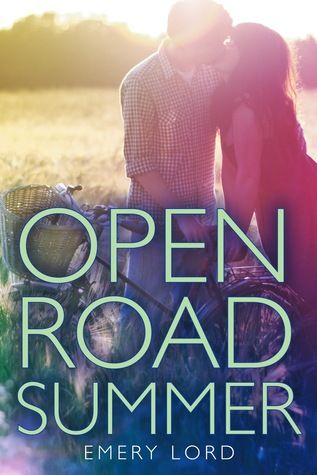
Review: Open Road Summer by Emery Lord

Title: Open Road Summer
Author: Emery Lord
Publisher: Walker
Publication date: April 15, 2014
Rating: ★★★½

Summary (via Goodreads):

After breaking up with her bad-news boyfriend, Reagan O’Neill is ready to leave her rebellious ways behind... and her best friend, country superstar Lilah Montgomery, is nursing a broken heart of her own. Fortunately, Lilah’s 24-city tour is about to kick off, offering a perfect opportunity for a girls-only summer of break-up ballads and healing hearts. But when Matt Finch joins the tour as its opening act, his boy-next-door charm proves difficult for Reagan to resist, despite her vow to live a drama-free existence. This summer, Reagan and Lilah will navigate the ups and downs of fame and friendship as they come to see that giving your heart to the right person is always a risk worth taking. 

Open Road Summer is a lighthearted summertime read with a strong friendship and the kind of romance we've all probably daydreamed about at some point. However, there are a bunch of things that niggled at me, which made for less pleasant reading experience overall.

Reagan is an interesting narrator – aggressively defensive (how's that for an oxymoron?), rebellious but reforming, fiercely loyal. She reminds me of Nastya from Katja Millay's The Sea of Tranquility, which, incidentally, I disliked so much that I could not read past page 49. Both Reagan and Nastya are a little bit cynical. They wear this protective layer – a "don't mess with me" look on their faces – and it feels like they are constantly daring the universe to try and do its worst. Their affection is hard won, and they are both judgmental, often holding other girls to the same double standards that they scoff. There's quite a bit of condescending girl hate in Open Road Summer, which is one of my biggest pet peeves in a book.

Fortunately, Reagan is a little more tolerable than Nastya. I think a big part of it is that her friendship with Dee makes you see her in a better light, in spite of all her flaws. Dee is your standard all-American country singer. I equate her to Taylor Swift, except authentically Southern and possibly a bit more squeaky clean. Dee and Reagan seem to be complete opposites, so it makes their relationship unexpected but endearing.

The romance in this book isn't particularly electric, but it's definitely very sweet. There are a handful of passages that make you sigh and want to go listen to the old love songs from Taylor Swift's self-titled album. (Or was that just me?)

If we could capture feelings like we capture pictures, none of us would ever leave our rooms. It would be so tempting to inhabit the good moments over and over again. But I don't want to be the kind of person who lives backwardly, who memorializes moments before she's finished living in them. So I plant my feet here on this hillside beside a boy who is undoing me, and I kiss him back like I mean it.

Matt Finch of former boy band fame (he's somewhere between Hanson and the Jonas Brothers in my head) is your average Nice Guy™ – kind, witty, very persistent, quite sassy... He's normal, which makes him immediately likable. He's perhaps not a character you might fall in love with, but you can certainly see why someone else might. The banter between Matt and Reagan is well-written and realistic. In fact, most of the dialogue in Open Road Summer feels that way – realistic, candid, unforced – despite the fact that we're talking about a major country singer, a former pop star, and a summer-long cross-country tour.

Parts of this book do feel trivial – the conflict is somewhat self-imposed and you can't help but wonder why everyone's making such a big deal out of everything. At the same time, although they are kind of silly, the problems in Open Road Summer aren't the type that weigh heavy on your heart once you close the book. It's a carefree novel that makes you appreciate good friends and innocent love. Quick and easy to read, Open Road Summer is a solid debut from Emery Lord. Summer's almost over but this book helps it live on.

Friday, July 18, 2014

Review: To All the Boys I've Loved Before by Jenny Han

Title: To All the Boys I've Loved Before
Author: Jenny Han
Publisher: Simon & Schuster
Publication date: April 15, 2014
Rating: ★★★½

Summary (via Goodreads):

Lara Jean Song keeps her love letters in a hatbox her mother gave her. They aren't love letters that anyone else wrote for her; these are ones she's written. One for every boy she's ever loved – five in all. When she writes, she pours out her heart and soul and says all the things she would never say in real life, because her letters are for her eyes only. Until the day her secret letters are mailed, and suddenly, Lara Jean's love life goes from imaginary to out of control.

To All the Boys I've Loved Before is not the kind of book I want to be caught reading on the subway. The entire cover reeks of starry-eyed girl mooning over, well, all the boys she's loved before. And yet... fanciful cover or not, after skimming the summary, I knew immediately that this was the kind of book that would resonate with me.

Let's face it. I'm exactly the kind of girl who falls in love with strangers, who invents a lifetime of stories about a person without even having to see their face, who may or may not have filled pages in my journal about what-ifs and could've-beens and where-are-they-nows. So when this book came into my library, I was beyond excited to read it.

"What is it with girls and rain?" Peter wonders.

"I don't know... I guess maybe because everything feels more dramatic in the rain," I say with a shrug.

"Did anything actually happen with you two, or were you just standing out in the rain picking up soccer balls?”

We may as well get this out of the way: To All the Boys is by no means a particularly refined book. The writing can be distracting at times. Most notably, our main character Lara Jean Song reads like a 13-year-old, even though she's a junior in high school. And I'll admit, the writing occasionally gave me some major Babysitters Club vibes. (Generally speaking, that isn't a problem for me because I'm quite a big fan of the BSC, but I imagine it's a turn-off for many other readers.)

I will note, however, that when I was 16-going-on-17, I probably sounded and acted the same as Lara Jean. It's a side-effect of living in a comfortable place – read: the suburbs – and having others around to take care of you. Lara Jean is mothered by Margot, to the point where she can't feel confident in her own decisions without some external validation. She exists in la la land where life, for the most part, is roses and daisies and daffodils. In a lot of ways, that's how I was in high school: sheltered, young, and naive. So yes, Lara Jean may have sounded like a child, but it's not unrealistic, nor is it necessarily an inaccurate portrayal of a 16-year-old girl.

Despite the writing level,  I really enjoyed this book precisely because of the characters. It is uncanny how much I identified with Margot, Lara Jean, and Kitty each. In very specific ways, too. It felt as if I could combine all of their weird quirks to form a rough picture of myself.

Also – I'm just going to be blunt here – it's nice to read a main character who is funny and silly and intelligent and sure-footed (in some parts of her life, at least) and normal and not white. I mean, how refreshing is it to see an actual Asian girl on a book cover?! I loved all the bits and pieces of culture that were embedded into this book. I constantly found myself laughing along and nodding.

Lara Jean has such a rich relationship with her family. I continue to believe family dynamics are fascinating, and while the Song family isn't particularly complex, they are still a joy to explore. I particularly adored the development of Lara Jean's relationship with Kitty – the initial clashing and then the closeness that formed as a result of Margot going off to college. The character growth in To All the Boys was an understated kind. Incremental, slow. It was made apparent only when Margot returned for Christmas break and "suddenly" Lara Jean had her own opinions, thoughts, desires. Sure, maybe it felt like nothing was happening, but isn't that how life is sometimes? You change and grow; your hair gets a fraction longer; days pass, and then weeks, and before you know it, you're different, not quite who you once were.

When someone's been gone a long time, at first you save up all the things you want to tell them. You try to keep track of everything in your head. But it's like trying to hold on to a fistful of sand: all the little bits slip out of your hands, and then you're just clutching air and grit. That's why you can't save it all up like that.

Because by the time you finally see each other, you're catching up only on the big things, because it's too much bother to tell about the little things. But the little things are what make up life.

Sadly, the ending of To All the Boys was a bit of a disappointment. It felt abrupt, to say the least. The resolution between Margot and Lara Jean seemed overly convenient. There was practically no mention of Josh, which is odd, given that a big chunk of this book was indirectly about him. Genevieve disappeared, which I thought unfair, and Lara Jean's relationship with Peter was left hanging.

According to Jenny Han, there WILL be one more book, which I hope will provide some much needed resolution. I still wish this could have been a tighter story – I'm a big fan of standalone novels; who's got all that shelf space anyway? – but I'll be generous here. This book has many flaws, absolutely. But it has many redeeming elements as well.

Margot would say she belongs to herself. Kitty would say she belongs to no one. And I guess I would say I belong to my sisters and my dad, but that won't always be true. To belong to someone – I didn't know it, but now that I think about it, it seems like that's all I've ever wanted. To really be somebody's, and to have them be mine.

To All the Boys I've Loved Before is ultimately a story filled with truths. It's a candid exploration of love and relationships. Lara Jean wonders if there's a difference between belonging to and belonging with someone – and maybe the words do matter, and maybe it's just semantics. Either way, it's a curious thing to think about. Equally interesting is the way we come to love people... the way distance can shape a relationship... the way time can corrode it.

If there's one thing that this book has reinforced for me, it's that relationships are both fragile and strong. They are malleable, never fixed. One day, a person may not remember you exist. The next, you run into them at a Model UN conference and they can't stop thinking about you for weeks. That's the allure of this book. It's a study in possibilities, and sometimes the possibilities seem endless.