Thursday, September 15, 2016

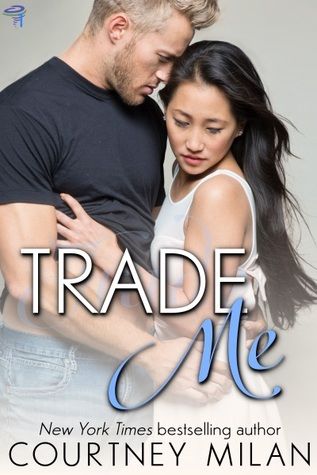
Trade Me by Courtney Milan

Title: Trade Me (Cyclone #1)
Author: Courtney Milan
Publisher: Courtney Milan
Publication date:  January 19, 2015
Rating: ★★★★

Summary (via Goodreads):

Tina Chen just wants a degree and a job, so her parents never have to worry about making rent again. She has no time for Blake Reynolds, the sexy billionaire who stands to inherit Cyclone Technology. But when he makes an off-hand comment about what it means to be poor, she loses her cool and tells him he couldn’t last a month living her life.

To her shock, Blake offers her a trade: She’ll get his income, his house, his car. In exchange, he’ll work her hours and send money home to her family. No expectations; no future obligations.

But before long, they’re trading not just lives, but secrets, kisses, and heated nights together. No expectations might break Tina’s heart...but Blake’s secrets could ruin her life.
I have NO appropriate words to describe how much I loved this book, even with its lackluster resolution. Every time I think about Blake and/or Tina, I just want to puke in enthusiasm.

I mean, an Asian female MC in a new adult book?

An Asian female MC in a new adult book who is actually bright, and driven, and sex-positive, and proud of her family, and not fetishized, and compassionate, and socially aware? A character that I can actually relate to??!?

Pinch me. I must be dreaming.

Tina Chen is the main reason I picked up this book. I needed to read a new adult novel that was not all about white people. And you know what? She struck a deep chord with me.

I always, always love a female MC who shies away from love and commitment. I love a girl who thinks relationships are dangerous, who believes in protecting herself (and her family) first. I AM THAT GIRL. And Tina is that girl. She has to grapple with safety and risk, and contend with her interest in the perfect-by-traditional-Western-standards Blake Reynolds.

Blake is fascinating. He's imperfect and flawed in ways that matter. Despite his ignorance and privileged upbringing, he respects people. He makes mistakes but he learns and tries to do better – he is everything I wish the people of the Internet would be. (Ahem.)

Tina and Blake are compelling on their own, but when they're together, it's impossible to drag your eyes away. Their dynamic is so interesting – the back and forth, give and take. They make each other feel understood. They make each other feel good. They call it like it is. They speak openly. They don't play games. It's so goddamn refreshing to see two intelligent adults acting like intelligent adults in a relationship. How annoying is it when the key conflict in a story could be resolved by a couple actually communicating with each other? There's none of that nonsense here. The conflicts and challenges they face actually matter; they're complicated. There's no easy way out.

Blake is a complex person with a complex relationship with his father; for better or for worse, it colors his life and the decisions he makes, and it is because of this that the "issues" in this book don't feel like "issues." The problems and solutions, as Blake says, are "all tangled up, knitted together so firmly that you can't excise the problem without blowing the solution to bits." Courtney Milan has certainly knitted together a story where that's the case, though I do wish the "solution" had been somewhat less anti-climactic. The end came together rather quickly and rather too conveniently – before I knew it, the story was over. I wish we had gotten to see a little more romance between Tina and Blake. Softer, slower moments. A little more lingering instead of a constant rush forward.

Maybe because of the way it was written – with scenes that propelled the story forward – I read this book in 5 hours. I devoured it. And on my commute to work this morning, I started reading it again. To savor it. To revisit and reconsider my thoughts on relationships. To bask in the existence of a well-written Chinese female character. A well-written Chinese female character, written well by a non-Chinese author. (I mean, whaaaa???? Side-eye emoji. Side-eye emoji. Side-eye emoji.)

This is the part where I don't really know what else to say. Trade Me made me laugh. It made me cry. It made me feel like I was learning something. It was a really smart book. It made me feel seen. It made me have some degree of faith in humanity. (No joke.)

Read this book if you're tired of never seeing yourself in books.
Read this book if you want to see relationships based on mutual respect.
Read this book if you like your parents.
Read this book if you don't.

Read this book if you think stories should mean something. Because this one does.

Tuesday, June 7, 2016

Review / Truthwitch by Susan Dennard

Title: Truthwitch (The Witchlands #1)
Author: Susan Dennard
Publisher: Tor Teen
Publication date: January 5, 2016
Rating: ★★★★

Summary (via Goodreads):

On a continent ruled by three empires, some are born with a “witchery”, a magical skill that sets them apart from others.

In the Witchlands, there are almost as many types of magic as there are ways to get in trouble – as two desperate young women know all too well.

Safiya is a Truthwitch, able to discern truth from lie. It’s a powerful magic that many would kill to have on their side, especially amongst the nobility to which Safi was born. So Safi must keep her gift hidden, lest she be used as a pawn in the struggle between empires.

Iseult, a Threadwitch, can see the invisible ties that bind and entangle the lives around her—but she cannot see the bonds that touch her own heart. Her unlikely friendship with Safi has taken her from life as an outcast into one of reckless adventure, where she is a cool, wary balance to Safi’s hotheaded impulsiveness.

Safi and Iseult just want to be free to live their own lives, but war is coming to the Witchlands. With the help of the cunning Prince Merik (a Windwitch and ship’s captain) and the hindrance of a Bloodwitch bent on revenge, the friends must fight emperors, princes, and mercenaries alike, who will stop at nothing to get their hands on a Truthwitch.

A list of things I loved about Truthwitch:

1: Safi and Iseult's BFFship. Totally heartfelt and inspiring and honestly not forced or cheesy at all. They have their own lives, they hustle, but they depend on each other and they take care of each other and they prioritize each other's needs before their own. It's awesome, and it makes me want to find a like-minded assassin/thief BFF to Netflix and chill with on the weekends.

2: The characters, who are all even better than I could have imagined. Every single one of them.

2a: Uncle Eron, Safi's perpetually drunk uncle. He doesn't feature that heavily in this book, but goddamn if he doesn't make your head spin.

2b: Iseult. She is so easy for me to relate to (I love her "aloofness" and I really understand the struggle between feeling too much and not feeling enough). She's probably the second most compelling character to me, the first being...

2c: Aeduan – what a cranky snarl ball! All throughout her promotional interviews and tours, Susan Dennard kept emphasizing that Aeduan may or may not be a villain, and I kept thinking to myself, "Yeah, yeah, he's bad on the outside but good on the inside (#MorallyComplicatedYA)." I was convinced he'd start off as a terrible person, but turn into a dark Prince Charming halfway through the book. Easy peasy. But no – Susan Dennard has some tricks up her sleeve. Aeduan is such an interesting character – so similar to Iseult in that he's learned to distance himself from his emotions – with an even more interesting background that I'm excited to explore over the course of the next few books.

2d: Kullen! I have a crush on Kullen! I want a novella about him and Ryber!

2e: Merik! I did not think I was going to fall for Merik. I'm not usually a sucker for the handsome prince with washboard abs, but everything changed with these four words: "Your loss, I promise." (!!!) I reread that sentence, like, FIFTY TIMES and blushed for the rest of the day.

3: Being able to jump from one character's perspective to another. Variety is the spice of life, and it's really fun to be able to hop around from location to location and experience so many different things in this huge, wonderful world.

4: The moments when characters start to fall in love. There are so many magical scenes littered throughout the book that really shine. Such a treat to read.

5: The action. Listen – I'm not the biggest fan of action-adventure stories because (a) I'm a crybaby scaredy-cat and (b) I'm more of a sucker for stories with lots of navel-gazing, sadness, and angst. But the action in Truthwitch is fantastic. It's what propels the story forward. It's compelling and exciting, and it's impossible not to turn the page.

With all that being said, there are two things keeping me from liking Truthwitch more. The writing is awkward at times – it feels a little bit too conversational, almost like the author is sitting next to me, telling me the story, rather than me reading and being fully immersed in it. But that's totally a personal preference – I'm sure others will see this and have NO clue what I'm talking about.

The pacing is the other thing that bothered me about this book. The story starts out with a bang – you're thrown into this world that is huge and complicated, and it takes a while before you really understand what's going on. And then the story slows down a lot. In the first half, you're mostly getting grounded in the historical and political context of the Witchlands, while the second half is where the story really gets off the ground. It's a bit of a slog, and I do wish that those details had been explained more efficiently... but hopefully that just means that once Book 2, Windwitch, is published, we'll be familiar with the context already and it will be smooth sailing from there. (Get it? Because he's a sailor/ship captain? Right? *slinks away*)

Wednesday, May 25, 2016

Eleven Hours by Pamela Erens

Title: Eleven Hours
Author: Pamela Erens
Publisher: Tin House
Publication date: May 2, 2016
Rating: ★★★★

Summary (via Goodreads):
Lore arrives at the hospital alone—no husband, no partner, no friends. Her birth plan is explicit: she wants no fetal monitor, no IV, no epidural. Franckline, a nurse in the maternity ward—herself on the verge of showing—is patient with the young woman. She knows what it’s like to worry that something might go wrong, and she understands the pain when it does. She knows as well as anyone the severe challenge of childbirth, what it does to the mind and the body.

Eleven Hours is the story of two soon-to-be mothers who, in the midst of a difficult labor, are forced to reckon with their pasts and re-create their futures. Lore must disentangle herself from a love triangle; Franckline must move beyond past traumas to accept the life that’s waiting for her. Pamela Erens moves seamlessly between their begrudging friendship and the memories evoked by so intense an experience. At turns urgent and lyrical, Erens’s novel is a visceral portrait of childbirth, and a vivid rendering of the way we approach motherhood—with fear and joy, anguish and awe.

Many thanks to the publisher for sending me this electronic copy via NetGalley in exchange for my honest review.

This book is SO "literary." It feels like a grad school writing prompt gone wild. But in a good way. (Really, what else would you expect from a publisher like Tin House?)

I requested Eleven Hours on NetGalley because I recognized the author, Pamela Erens. (Someone had recommended her previous book, The Virgins, as a better (less racist? - my words, not theirs) version of Eleanor & Park.) I haven't yet read The Virgins, but suffice it to say I was interested in her work.

The story is told from a third person perspective, following two characters - Lore Tannenbaum and her midwife Franckline. For me, Lore is the more compelling of the two, so I will focus on her here.

At the onset, Lore is not the most likable character. She is demanding and cool - perhaps too outwardly emotionless and independent for her own good. It's not easy to empathize with her, and the story's slightly detached point of view doesn't make it any easier. As the book progresses, we find out more about her relationships and the emotional pain she has experienced - all of the things that have led her to where she is at that moment - and though it doesn't exactly make us like her any better, it feels like we slowly come to understand her.

On a personal level, I found myself fiercely rooting for her. I understood her - I understood her compulsion to push people away in order to protect herself. I understood her need for control. I understood her seemingly cold nature and unwillingness to let herself get attached. It was fascinating to experience her journey through pregnancy, as well as her shifting attitudes toward this child that she carried.

My investment in Lore's wellbeing surprised even myself - I am not one for books about motherhood. I can barely stomach mommy blogs. A story about a woman giving birth? The miracle of life? Ummm. Thanks but no thanks. And yet I found Eleven Hours to be a surprisingly gripping read - there's just enough suspense to keep you turning the pages. For those of you who think books about birth are boring, THINK AGAIN. Birth is freaking terrifying and gory. It's like voluntarily turning your life into a horror film. Women are badass.

But I digress.

The book goes back and forth between past and present, shifting from a focus on Lore's life to Franckline's. The story seems to wander leisurely, the tension slowly building as Lore gets closer and closer to birth.

The writing really is something. Ideas are expressed so articulately - you'll read something and think, "Yes, exactly. That's exactly what it feels like." In some ways, I feel the writing is much stronger than the story. And in fact, Eleven Hours feels like less of a "story" and more like an exercise in empathy - it's like the author wanted to take a not-particularly-likable character and make the reader want to fight for her by the end of the story, whether or not you've experienced motherhood or pregnancy yourself. Whatever the intention, it worked for me. I am much more conscious and simultaneously in a state of awe and fear of pregnancy after reading this book. Lore Tannenbaum is certainly not someone I'll forget in a jiffy.

Tuesday, January 19, 2016

Review: Echo by Pam Muñoz Ryan

Title: Echo
Author: Pam Muñoz Ryan
Publisher: Scholastic Press
Publication date: February 24, 2015
Rating: ★★★★

Summary (via Goodreads):

Lost and alone in a forbidden forest, Otto meets three mysterious sisters and suddenly finds himself entwined in a puzzling quest involving a prophecy, a promise, and a harmonica.

Decades later, Friedrich in Germany, Mike in Pennsylvania, and Ivy in California each, in turn, become interwoven when the very same harmonica lands in their lives. All the children face daunting challenges: rescuing a father, protecting a brother, holding a family together. And ultimately, pulled by the invisible thread of destiny, their suspenseful solo stories converge in an orchestral crescendo.

Richly imagined and masterfully crafted, ECHO pushes the boundaries of genre and form, and shows us what is possible in how we tell stories. The result is an impassioned, uplifting, and virtuosic tour de force that will resound in your heart long after the last note has been struck.

Pam Muñoz Ryan was one of those authors I was lucky enough to discover at an early age. I happened to randomly pick up Esperanza Rising at a school book fair way back in 2000 and it immediately became one of my favorite books. I must have read it a dozen times, I loved it so much – so when I read an article a few months back that she had won the Kirkus Prize for Young Readers' Literature for her new book, Echo, and when I saw it at a bookstore a few weeks later, I knew I couldn't leave it behind.

Echo is a gorgeous book, from the way the cover and pages are designed, to the imagery and the way the setting is described (which, in my opinion, has always been one of the author's greatest strengths), to the magical storytelling – a fairytale that briefly follows the lives of three children living in three different "eras" in history: Hitler's Germany, the Great Depression, and post-WWII segregation in the United States. Broken into separate narratives, Friedrich, Mike, and Ivy's experiences are each filtered through an historical backdrop. The tension slowly builds and the stakes continue to rise until each of their tales reaches a climax... and then, strangely, it's like the book just fades to black.

This is my biggest gripe, and it's also why I think Echo feels a bit like a beautiful writing project – because it starts with a thread of an interesting concept (a prophecy and a harmonica), but it doesn't get developed in a gratifying way. The pacing is off. Pam Muñoz Ryan lays the foundation for an important chapter in each of these characters' lives, and at the most gripping moment, she cuts off the story. We find out what happens later on, but by then she's just telling us what we missed, a passive recap that feels like a letdown. At nearly 600 pages, this book is already quite hefty, but I actually wish the author had drawn out the story even more.

I'm not sure if it's because Echo is labeled as a middle grade book that the conflict resolution is lacking (I've had a similar observation with other MG books I've read – perhaps the more sordid bits are not deemed appropriate or relevant for younger readers?), but either way it's a shame. For me, this book could have been a five-star read if only the story felt more complete. Everything else is there – the subtle bits of magical realism that sweep you away, the characters that you can't help but root for, the diversity of their backgrounds and experiences, the beautiful writing, the story's overall brilliant premise, and the way everything comes full circle...

Normally, a gaping plot hole would make me dismiss a book entirely, but what makes me relent is the fact that, quite simply, this novel is about hope. It's about three young protagonists, and how a harmonica comes into their lives at exactly the right time, and how it connects them all, and how things happen for a reason. Synchronicity, you could say. So, to that end, I can somewhat come to terms with the author's decision to exclude the parts that she did... because the whole is more than just the sum of its parts, and in Echo, there's something much bigger at play.

Your fate is not yet sealed. Even in the darkest night, a star will shine, a bell will chime, a path will be revealed.

Wednesday, December 9, 2015

The Longest Night by Andria Williams – Like Playing a Sad Song on Repeat

Title: The Longest Night
Author: Andria Williams
Publisher: Random House
Publication date: January 12, 2016
Rating: ★★★★

Summary (via Goodreads):

In 1959, Nat Collier moves with her husband, Paul, and their two young daughters to Idaho Falls, a remote military town. An Army Specialist, Paul is stationed there to help oversee one of the country’s first nuclear reactors – an assignment that seems full of opportunity.

Then, on his rounds, Paul discovers that the reactor is compromised, placing his family and the entire community in danger. Worse, his superiors set out to cover up the problem rather than fix it. Paul can’t bring himself to tell Nat the truth, but his lies only widen a growing gulf between them.

Lonely and restless, Nat is having trouble adjusting to their new life. She struggles to fit into her role as a housewife and longs for a real friend. When she meets a rancher, Esrom, she finds herself drawn to him, comforted by his kindness and company. But as rumors spread, the secrets between Nat and Paul build and threaten to reach a breaking point.

Based on a true story of the only fatal nuclear accident to occur in America, The Longest Night is a deeply moving novel that explores the intricate makeup of a marriage, the shifting nature of trust, and the ways we try to protect the ones we love.

Many thanks to Random House for sending me this electronic copy via NetGalley in exchange for my honest review.

Andria Williams makes a gorgeous authorial debut with The Longest Night, a story that explores one family's complex, tangled relationships with neighbors, with friends, and with each other. Williams throws us into a sleepy town where much of life revolves around the presence of one of the country's earliest nuclear reactors. From the start, we know that something's not quite right with the ol' CR-1, and this feeling of unease grows and grows until we reach a tipping point. It's hard to imagine that The Longest Night is based on a true story: the events feel like they're straight out of a science fiction plot, and the 1950s have never felt so iconic yet, strangely, so unimaginable.

The high tension setting provides the perfect backdrop for the messy interpersonal dynamics in the story. Interactions between Nat and Paul, husband and wife, feel more loaded somehow – as though the two are dancing on shaky ground. Every observation feels sharper, more significant, more pressing. Paul reflects on his life before Nat, while Nat reflects on who she was then and who she is now; and meanwhile you're sitting there thinking about the complexity of marriage and love and friendship – how we sometimes fall into things and how, for better or for worse, time turns relationships into something you had never expected.

And so, when Nat is presented with a choice, a fork in the road, it's difficult to say which way she should go. There's no black and white answer – Williams develops the story and these characters in a way that makes it so easy to understand and justify their actions and thoughts, even if you know that they're walking a fine line, teetering somewhere between status quo and free-fall. Throughout the book, you feel as though these characters are forever playing with something, some force, that is beyond them – whether it's the nuclear reactor, or the institution of marriage, or the expectations of society in the 50s... And maybe you know what they should do, how they should respond, but if you're being totally honest with yourself, you find that mostly you just want them to shirk the responsibilities and obligations, and instead choose the path that will give them the greatest happiness.

As I reflect on Williams' story, I'm realizing that this entire book is a study in character – in people, in who we are and who we become and how people affect us and shape us over time. At its heart, this is a story of life and desire and the values we carry with us. The characters in The Longest Night are fascinating: flawed and fucked up, and still there's something that keeps you turning the pages, wanting to know more about them, even if you can't.

And isn't that just so true to life? You can never know a person's entire story. All you can do is watch and observe and make sense of actions and try to draw out meanings from things and people that are unknowable. And there's something sacred about that. Andria Williams puts it brilliantly, this pleasure of not quite knowing:

I wanted to keep that moment where he was so grown-up and so perfect that I wasn’t quite sure it was really him. I wanted to keep it like I could have it forever and ever, over and over, that feeling of recognizing.

That's what this book is. It's not knowing. It's ambiguous. It's disturbing. It's unfair. It doesn't have a perfectly happily ever after ending – but it's okay, because this book is a reflection of life and there's no such thing as a neat resolution. And by the time you get to the last page, you don't really want the disingenuous fairytale ending anyway. What you want is something that feels real – and that real-ness is what you get. The Longest Night feels a little bit like a sad song, but it's a song you want to play over and over again.

Thursday, August 6, 2015

Review: Everything, Everything by Nicola Yoon

Title: Everything, Everything
Author: Nicola Yoon
Publisher: Delacorte Press Books for Young Readers
Publication date: September 1, 2015
Rating: ★★★★

Summary (via Goodreads):

My disease is as rare as it is famous. Basically, I’m allergic to the world. I don’t leave my house, have not left my house in seventeen years. The only people I ever see are my mom and my nurse, Carla.

But then one day, a moving truck arrives next door. I look out my window, and I see him. He’s tall, lean and wearing all black – black T-shirt, black jeans, black sneakers, and a black knit cap that covers his hair completely. He catches me looking and stares at me. I stare right back. His name is Olly.

Maybe we can’t predict the future, but we can predict some things. For example, I am certainly going to fall in love with Olly. It’s almost certainly going to be a disaster.

Many thanks to Delacorte Press for sending me this electronic copy via NetGalley in exchange for my honest review.

I read somewhere that Everything, Everything is what you wish The Fault in Our Stars could have been. Both books explore rare illnesses, impossible love, intelligent characters with little quirks – but Everything, Everything is decidedly more hopeful, fortunately less pretentious (sorry, Augustus Waters), and appreciably more diverse. The story itself is written from Maddy's perspective, but it feels like a mixed media art project with Maddy's one-line book reviews (on Tumblr, of course), doctor's notes, illustrations (drawn by Nicola's husband!), chat logs, screenshots of Maddy's email inbox, even the chapter titles… all of which provide an interesting subtext to the story. In Everything, Everything we get to take a look at Maddy's world, where repetition, predictability, and structure are forever the big themes of the day, until Olly moves in next door and changes all of that.

For me, the storyline is what really makes me like the book – surprising, given that I'm always going on about characters and character development. (But I actually find Maddy to be perhaps too perfect, too likable, in this story. Even when she registers that her actions are hurtful, it's still always easy for the reader to justify and make sense of what she's doing. It's hard for me to actively root for her, and I think part of it is that I never fully get the impression that she truly "earns" the good things that happen to her. They just sort of… happen to her. I don't know. It is a feeling I cannot clearly explain or substantiate.)

I do love seeing Maddy fall in love for the first time. There is an element of insta-love here, but it's not wrong in and of itself, or out of place either – especially when you think about the amount of interaction Maddy has had with the outside world (read: practically none). No wonder Olly feels like a bolt of lightning. I actually find it strangely comforting to experience Maddy's feelings for him. It reminds me of all the intense crushes I had throughout high school and college, of things moving too fast, how your heart can swell with affection and infatuation in such a short period of time, how someone can creep into your thoughts without you even realizing.

Without spoiling the book, I'll just say that the ending is somewhat convenient. In some ways, it diminishes the story and resolves the conflict too easily. But that could just be my penchant for angst and for putting characters through hell to see if they can cope. I do appreciate that the "twist" adds a different kind of depth to the book by pulling other things to the surface: deep-seated issues in Maddy's relationship with her mother; the question of what it means to be alive and whether it is different from living; the futility in wondering how our lives might be different if only this had happened or if that had turned out differently; the realization that every little thing we experience, for better or for worse, brings us to who and where we are today.

All in all, despite my slight objections, Everything, Everything is a strong debut from Nicola Yoon and it totally deserves its Kirkus starred review. It's a well-crafted book (I wasn't exaggerating when I said it was a mixed media work of art), and it's such a delight to see things come full circle. You'll know what I mean when you get to the last page. Even if you do feel similarly about some of the issues I've called out, maybe you'll still sigh and marvel, like I did, at how brilliantly the story comes together all the same.

Monday, July 13, 2015

Review: P.S. I Still Love You by Jenny Han

Title: P.S. I Still Love You
Author: Jenny Han
Publisher: Simon & Schuster
Publication date: May 26, 2015
Rating: ★★★★

Summary (via Goodreads):

Lara Jean didn’t expect to really fall for Peter.

She and Peter were just pretending. Except suddenly they weren’t. Now Lara Jean is more confused than ever.

When another boy from her past returns to her life, Lara Jean’s feelings for him return too. Can a girl be in love with two boys at once?

In this charming and heartfelt sequel to the New York Times bestseller To All the Boys I've Loved Before, we see first love through the eyes of the unforgettable Lara Jean. Love is never easy, but maybe that’s part of what makes it so amazing.

Interestingly, what made me love the first book in this duology by Jenny Han made me dislike the second, and what made me dislike the first book made me love the second too.

The dynamic between Peter and Lara Jean was what made the first book so great. They were unexpected. They were in completely different social groups. They didn't make sense together… until they did. And then they made all the sense in the world, and they represented possibility and breaking the status quo, being something other than what is expected. All you wanted was to see Lara Jean and Peter being silly together, and Peter treating Kitty like she was his own sister, and Peter acting like his smarmy self but regarding Lara Jean's Korean culture with so much respect.

And there was definitely still some of that charm in P.S. I Still Love You – like Kitty with her blunt observations:

"It looks like sex to me, but I'm the only one here besides you who's never had sex, so what do I know? Sorry, I read your diary."

And Lara Jean with her social awkwardness (doesn't this sound like a scene straight out of The Mindy Project? Like, "Ugh, Danny, why are you such a slow reader?" Anyone?):

"It's torturous standing there in front of him, waiting – for what, I don't know. More humiliation? I should probably just go. He's such a slow reader."

But the more I learned about Peter, the more easily I fell out of love with him, and I was frustrated with Lara Jean for not feeling the same way. He had moments where he would just sparkle, where he would say exactly the right thing, and you could tell it was for real and not just some line he was feeding her, and I could understand Lara Jean not wanting to let him go, but… I just… ugh. It didn't feel like enough to me. He acted in ways that canceled out what made him so great.

I need to do a whole separate post on this. I have a lot of feelings about Peter, and they are not good feelings.

Moving right along…

As he was meant to do, John Ambrose McClaren captured my heart with his gentlemanliness. It was unexpected and a tiny bit scary, too, to realize that falling in love is just a game of chance. It reminds me of something I learned in a human development class I took in college – there are currently 7+ billion people on this world, and literally millions of those people could be your potential [soul]mate, but if you don't encounter them, then it doesn't matter. And it comes down to timing, and circumstance, and even if you do find them, and even if you manage to fall in love with them, you still have to make an effort to make it work.

I wasn't expecting such a blunt, realistic view of the world from this book, especially since the first book felt so much younger and more innocent to me. It didn't feel out of place, necessarily – rather, I think it showed Lara Jean growing up, confronting the hurtful moments in her life and trying to make sense of them:

"Things feel like they'll be forever, but they aren't. Love can go away, or people can, without even meaning to. Nothing is guaranteed."

P.S. I Still Love You was a little darker, not quite as dreamy or rosy as To All the Boys I Loved Before – and I really liked that about it. But I didn't love Peter, and it was a huge letdown, and I guess that's a big part of why I couldn't love this book.

On a lighter note, did anyone else notice that Lara Jean made Taylor Swift's chai sugar cookies with [cinnamon] eggnog frosting? (And since I'm on the subject, did anyone else feel like P.S. I Still Love You was basically "That's the Way I Loved You" in book form? Please discuss.)

Wednesday, July 1, 2015

Mini-Review: The Storied Life of A.J. Fikry by Gabrielle Zevin

Title: The Storied Life of A.J. Fikry
Author: Gabrielle Zevin
Publisher: Algonquin Books
Publication date: April 1, 2014
Rating: ★★★★

Summary (via Goodreads):

On the faded Island Books sign hanging over the porch of the Victorian cottage is the motto "No Man Is an Island; Every Book Is a World." A. J. Fikry, the irascible owner, is about to discover just what that truly means.

A. J. Fikry's life is not at all what he expected it to be. Slowly but surely, he is isolating himself from all the people of Alice Island. Even the books in his store have stopped holding pleasure for him.

And then a mysterious package appears at the bookstore. It's a small package, but large in weight. It's that unexpected arrival that gives A. J. Fikry the opportunity to make his life over, the ability to see everything anew.

The Storied Life of A.J. Fikry is a book for people who love books. It's a whimsical and charming story, filled with insights into literature that remind us why books matter. The chapters are broken up with book blurbs written by bookseller A.J. Fikry. They feature his opinions on books and short stories and serve as letters to the people he comes to love best.

“Remember, Maya: the things we respond to at twenty are not necessarily the same things we will respond to at forty and vice versa. This is true in books and also in life.”

There's a sing-song quality in Gabrielle Zevin's writing that makes you feel like you're watching a Wes Anderson film. It's candid but theatrical somehow.

This is the type of book you read while sipping on a cup of tea, or while you're eating that turkey sandwich you made for lunch. It's the type of book you may enjoy best surrounded in normalcy, because it is a book of ordinary lives made extraordinary by the people in it. The connections between neighbors, the slow change in our perception of people, the slow change in ourselves – all of these things come alive in this book.

Written in third person perspective, we get a glimpse into many characters' lives. However, because of this "otherly" view, there is always a distance between us and this cast of characters. It's a gap that becomes difficult to bridge, which is why I'm giving this four stars.

The words you can't find, you borrow.
We read to know we're not alone. We read because we are alone. We read and we are not alone. We are not alone.
My life is in these books, he wants to tell her. Read these and know my heart.
We are not quite novels.
The analogy he is looking for is almost there.
We are not quite short stories. At this point, his life is seeming closest to that.
In the end, we are collected works.

Saturday, June 27, 2015

Review: A Sense of the Infinite by Hilary T. Smith

Title: A Sense of the Infinite
Author: Hilary T. Smith
Publisher: Katherine Tegen Books
Publication date: May 19, 2015
Rating: ★★★★

Summary (via Goodreads):

It's senior year of high school, and Annabeth is ready – ready for everything she and her best friend, Noe, have been planning and dreaming. But there are some things Annabeth isn't prepared for, like the constant presence of Noe's new boyfriend. Like how her relationship with her mom is wearing and fraying. And like the way the secret she's been keeping hidden deep inside her for years has started clawing at her insides, making it hard to eat or even breathe.

But most especially, she isn't prepared to lose Noe.

For years, Noe has anchored Annabeth and set their joint path. Now Noe is drifting in another direction, making new plans and dreams that don't involve Annabeth. Without Noe's constant companionship, Annabeth's world begins to crumble. But as a chain of events pulls Annabeth further and further away from Noe, she finds herself closer and closer to discovering who she's really meant to be – with her best friend or without.

I was so thrilled to receive my copy of A Sense of the Infinite – I had read Hilary T. Smith's debut novel, Wild Awake, last year and became obsessed with it. And I mean obsessed. (I made a playlist and everything.) So naturally I was really looking forward to reading her new book.

A Sense of the Infinite is a silently powerful read with strong writing. Hilary T. Smith is so good with words – she knows exactly how to romance a character's internal dialogue, how to take a feeling or a thought or a daydream and magnify it and give it a life of its own. The short chapters and vignettes that are interspersed through the book are especially striking. Short and (bitter)sweet. Sometimes the little things pack a punch.

I put my hand on a tree's bark and felt a quiet current of friendship there, like an underground spring.
Maybe it wasn't too late for me to freeze in a snowbank. It sounded almost dreamy, almost pleasant.
"Annabeth's wandered out and frozen," they'd say. "It's very sad."

The characters in A Sense of the Infinite all feel realistic, too – almost painfully so. Noe reminded me of all the mean girls I knew in high school, how they could be so friendly in your Spanish class one year and then see straight through you the next. I appreciated Bob, her school dietician, and how even as a "minor" character, he evolved in her eyes and become significant to her. I like that richness in character development in a story. I like when characters are meaningful.

I loved Annabeth's cousin Ava: the way she was so horrible early on, the changes we saw in her later. It's so true to life, isn't it? Sometimes people knock us down and want to hurt us and make our life hell, and then you encounter them again years later, and the circumstances have changed completely, and you just move on and move forward. Steven, Noe's boyfriend, was my most unexpected love – and I loved him fiercely, for his determination to befriend Annabeth, for his solidarity with her, for his vulnerability and emotional struggles. They have such a beautiful, supportive relationship, and it was so nice to read.

Steven's tears and snot were soaking into my sweater. The daisies in his hair were getting crushed, the white petals curling in. I pulled the vial of lavender oil out of my pocket and quietly anointed him on the wrists, forehead, and heart, thinking that the mysterious thing about love is that you don't have to know what you're doing in order to do it exactly right.

Be forewarned – this book covers some intense and gritty themes. Rape, pregnancy, eating disorders, depression, suicide, coming out, self-harm/mutilation... To be honest, this is one of the big reasons I didn't love this book. And it's not unrealistic, per se – in fact, between high school and my first year in college, I had to face all but one of those things in some capacity – but it just made this book feel so heavy and just too much. It's a somber book, for sure. But it's also a story of evolving relationships, and a story of transformation as we watch Annabeth struggle and grow, and that lightness helps balance out the rest.

If I'm being honest, I went in expecting nothing less than sheer and utter brilliance, which is a lot to ask of anyone but also just goes to show you how much I love Hilary's writing and how much I trust in her ability to tell a compelling story. This book feels a lot more YA in a way that Wild Awake didn't – it's so much about high school dynamics, being on the cusp of change, the fickleness and cruelty of people... But it's sophisticated and mature and kind of disturbing and kind of monumental.

Thursday, July 31, 2014

Review: Love and Other Perishable Items by Laura Buzo

Title: Love and Other Perishable Items
Author: Laura Buzo
Publisher: Knopf Books for Young Readers
Publication date: December 11, 2012
Rating: ★★★★

Summary (via Goodreads):

From the moment Amelia sets eyes on Chris, she is a goner. Lost. Sunk. Head over heels infatuated with him. It's problematic, since Chris, 21, is a sophisticated university student, while Amelia, 15, is 15.

Amelia isn't stupid. She knows it's not gonna happen. So she plays it cool around Chris – at least, as cool as she can. Working checkout together at the local supermarket, they strike up a friendship: swapping life stories, bantering about everything from classic books to B movies, and cataloging the many injustices of growing up. As time goes on, Amelia's crush doesn't seem so one-sided anymore. But if Chris likes her back, what then? Can two people in such different places in life really be together?

Ever since I finished reading Love and Other Perishable Items, I've been wavering on how I feel about it. On one hand, I love it a lot. It brings to mind favorites like The Piper's Son by Melina Marchetta and, to some extent, Megan McCafferty's Jessica Darling books. On the other hand, it still feels lacking, somehow. Or maybe it's just me who is left feeling empty.

The book is split between two perspectives. Part of the story is told through Amelia, who is young and hopeful and naive. The other part is revealed through pages from Chris' journal, filled with gritty truths, some dark humor, and the reality of a life not filtered through a rose-colored lens.

I could have provided strawberries, poetry and orgasms, but James, on the other hand, will provide a house in Vaucluse and a six-figure salary.

In this coming-of-age story, Amelia and Chris are ordinary people who are remarkably likable. Amelia is stuck in a bumbling stage of adolescence – she is socially awkward, giddy, childlike at times, but simultaneously struggling with very complex issues, including family dynamics, gender roles, and disappointing literature. Chris, in contrast, is legally an adult and participates in his fair share of adult activities, including alcohol consumption, drugs, and lots of sex. He's melodramatic, self-deprecating yet sanctimonious, hopelessly romantic. He lives in quiet desperation.

When I read back over what I'd written, I seriously thought about ripping out all the pages. It was a pretty poor showing all the way through, but when I got to the bit where I was writing out the lyrics from the Dire Straits "Romeo and Juliet" song, I had to rip that out.

But then, I really want to be more honest in this diary than I have been in past ones, so everything else stays in. It's bad enough that I present such a heavily edited version of myself to my friends and family; if I start editing my diary, it will reinforce my already overwhelming tendency to be gutless. But let us never speak of it.

For the record, she really did cry when we made love and said she loved me like the stars above and would love me until she died. But, you know, people say shit in the moment.

Chris and Amelia's relationship is fascinating to watch unfold. They are both caught in an in-between stage and seem to find kindred spirits in each other. What's hilariously frustrating and brilliant is that you actually kind of want it to work out between the two of them. Never mind that they're each in completely different places in life, with different wants and needs. Never mind that it's totally illegal and more than slightly sketchy on paper. They make each other happier and better, and they talk about things that matter, and you just want them together, for Pete's sake!

And yet... it's one of those universal relationship things, isn't it? Bad timing. You can't force something to happen through sheer willpower. The reality of life takes its course, and sometimes it's disappointing and sometimes it feels tragic.

5. Get together with Amelia. Accompany her to her tenth-grade formal. Fruitlessly try to convince her family that I am a perfectly decent chap. Ignore raised eyebrows from family and friends. Content myself with holding hands and kissing. Accompany Amelia on the upcoming round of her friends' sweet sixteen parties. Attempt to smuggle her into bars for my friends' birthday parties.

Unfortunately, for a coming-of-age story, Amelia never really changes in a significant way. She remains naive and idealistic – a true youngster – which is fine, except that she doesn't ever seem to learn anything. She remains enamored with Chris, and her relationship with her family doesn't evolve but for a small degree of increased understanding and disillusionment. In many ways, this book feels more like Chris' story than Amelia's.

All the same, at the end of the day, Love and Other Perishable Items remains a fascinating story. It scrutinizes contemporary feminism. It explores the failures of human nature as we eavesdrop on Chris and Amelia's conversations about fictional characters. It questions what growing up really looks like.

We learn that there's never a single line that we have to step across to enter adulthood. Sometimes we are shaped by unexpected revelations, disappointments, realizations that things aren't always black and white. Other times it's the choices we make that propel us into a new stage of living. Love and Other Perishable Items is innocent and gritty all at once. It never feels flowery or fluffy or unrealistic. It's the quiet but powerful story of imperfect characters who are just trying to find their way in the world. It's a story that lingers.

Monday, June 23, 2014

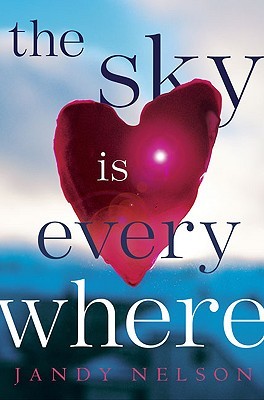
An Open Letter to Jandy Nelson

Title: The Sky Is Everywhere
Author: Jandy Nelson
Publisher: Dial
Publication date: March 9, 2010
Rating: ★★★★

Summary (via Goodreads):

Seventeen-year-old Lennie Walker, bookworm and band geek, plays second clarinet and spends her time tucked safely and happily in the shadow of her fiery older sister, Bailey. But when Bailey dies abruptly, Lennie is catapulted to center stage of her own life – and, despite her nonexistent history with boys, suddenly finds herself struggling to balance two. Toby was Bailey's boyfriend; his grief mirrors Lennie's own. Joe is the new boy in town, a transplant from Paris whose nearly magical grin is matched only by his musical talent. For Lennie, they're the sun and the moon; one boy takes her out of her sorrow, the other comforts her in it. But just like their celestial counterparts, they can't collide without the whole wide world exploding.

Dear Jandy Nelson,

When I started reading your book a few weeks ago, I was a little bit… skeptical. I couldn't really get into the story for the first 70-some-odd pages. I just don't care for books about grief. I don't like reading about people feeling helpless. Or hopeless. Or guilty for things that are out of their control. It makes me want to yell at them, "SNAP OUT OF IT! DO YOU KNOW HOW LUCKY YOU ARE TO BE ALIVE!" (Sometimes I can be insensitive like that.)

For the record, I also don't do well with love triangles. Leading people on is for the birds; we are responsible for our choices; etc. I guess the Joe/Toby thing was a necessary evil. A way to help Lennie come into her own and learn some important things about herself.

But still. I hate love triangles. Hate 'em. Why can't we all just be open and honest with each other? If we're not sure, we'll say we're not sure. If we know we're being idiots but we don't know why we're being idiots, we'll say that too. Maybe people would be much more tolerant and forgiving if we extended that level of courtesy to one another. Or maybe I'm a naive anomaly who thinks honesty is a greater virtue than it really is. It's possible.

There were times throughout the book when I would read something you wrote and be like, "Ugh NOOOO. Please don't let this sentence turn into the literary cliché that I think it's about to turn into…" and yes, sometimes the sentence would turn into that cliché. But you would still be three steps ahead and somehow lessen the clichéness of the cliché. Like when Joe told Lennie about being cheated on in France. I thought to myself, "Joe is obvi going to walk in on Toby/Lennie going at it," because that's what always happens in books and on TV, and it's what we – or at least I – have come to expect as media consumers. But two sentences later, Lennie is expressing almost the same thought as I did, as if she knows just how typical an ending like that might be.

Does all that even make sense? Maybe not. I guess I am just reveling in the synchronicity and the fact that it feels like you were giving me some credit as a reader. It was much appreciated whether or not it was purposeful.

Anyway. Moving on... The poems were brilliant. I've read (and written) my fair share of cringeworthy poetry, but Lennie's writing was different. Heavy and light and sophisticated and current and romantic and Victorian and desperate and crazy and strong. All of those things came through in Lennie's voice. And all the scraps throughout the book – and their captions – make so much more sense now that I've read through to the end. It feels cohesive, like an a-ha moment as I thumb through all the pages and see the candy wrappers and the cups and the carved-up tree branches.

I was totally wondering if you'd include the last poem in the book. It would have made sense if you had decided to leave it out. For starters, a poem with the power of reconciliation? I mean, that just borders on black magic. Second, what if it was a terrible poem? My last thought reading your book could have been, "Wow. That was truly dildonic." But again – and here's what I meant above – you were three steps ahead and the poem was right and perfect and it's like you had thought through all these things and thought about it from the perspective of both a writer and a reader and you gave us something that worked and worked beautifully.

So I just have to say: You're an awesome writer and I completely respect and admire your artistry. Writing is a craft, and The Sky Is Everywhere was a really clear reminder of that.

Thanks for a thought-provoking reading experience.

My very best,
Tiffany

P.S. I made it through graduated from Cornell too, so we are basically soul sisters! Kind of. Not really.

P.P.S. I was also initially convinced you were an Aussie writer. I have this theory that there is something in the water that turns all Aussie writers into super-writers. Like Melina Marchetta and Vikki Wakefield and Lucy Christopher. But you're not Aussie. (You're still a super-writer though.)