Thursday, July 31, 2014

Review: Love and Other Perishable Items by Laura Buzo

Title: Love and Other Perishable Items
Author: Laura Buzo
Publisher: Knopf Books for Young Readers
Publication date: December 11, 2012
Rating: ★★★★

Summary (via Goodreads):

From the moment Amelia sets eyes on Chris, she is a goner. Lost. Sunk. Head over heels infatuated with him. It's problematic, since Chris, 21, is a sophisticated university student, while Amelia, 15, is 15.

Amelia isn't stupid. She knows it's not gonna happen. So she plays it cool around Chris – at least, as cool as she can. Working checkout together at the local supermarket, they strike up a friendship: swapping life stories, bantering about everything from classic books to B movies, and cataloging the many injustices of growing up. As time goes on, Amelia's crush doesn't seem so one-sided anymore. But if Chris likes her back, what then? Can two people in such different places in life really be together?

Ever since I finished reading Love and Other Perishable Items, I've been wavering on how I feel about it. On one hand, I love it a lot. It brings to mind favorites like The Piper's Son by Melina Marchetta and, to some extent, Megan McCafferty's Jessica Darling books. On the other hand, it still feels lacking, somehow. Or maybe it's just me who is left feeling empty.

The book is split between two perspectives. Part of the story is told through Amelia, who is young and hopeful and naive. The other part is revealed through pages from Chris' journal, filled with gritty truths, some dark humor, and the reality of a life not filtered through a rose-colored lens.

I could have provided strawberries, poetry and orgasms, but James, on the other hand, will provide a house in Vaucluse and a six-figure salary.

In this coming-of-age story, Amelia and Chris are ordinary people who are remarkably likable. Amelia is stuck in a bumbling stage of adolescence – she is socially awkward, giddy, childlike at times, but simultaneously struggling with very complex issues, including family dynamics, gender roles, and disappointing literature. Chris, in contrast, is legally an adult and participates in his fair share of adult activities, including alcohol consumption, drugs, and lots of sex. He's melodramatic, self-deprecating yet sanctimonious, hopelessly romantic. He lives in quiet desperation.

When I read back over what I'd written, I seriously thought about ripping out all the pages. It was a pretty poor showing all the way through, but when I got to the bit where I was writing out the lyrics from the Dire Straits "Romeo and Juliet" song, I had to rip that out.

But then, I really want to be more honest in this diary than I have been in past ones, so everything else stays in. It's bad enough that I present such a heavily edited version of myself to my friends and family; if I start editing my diary, it will reinforce my already overwhelming tendency to be gutless. But let us never speak of it.

For the record, she really did cry when we made love and said she loved me like the stars above and would love me until she died. But, you know, people say shit in the moment.

Chris and Amelia's relationship is fascinating to watch unfold. They are both caught in an in-between stage and seem to find kindred spirits in each other. What's hilariously frustrating and brilliant is that you actually kind of want it to work out between the two of them. Never mind that they're each in completely different places in life, with different wants and needs. Never mind that it's totally illegal and more than slightly sketchy on paper. They make each other happier and better, and they talk about things that matter, and you just want them together, for Pete's sake!

And yet... it's one of those universal relationship things, isn't it? Bad timing. You can't force something to happen through sheer willpower. The reality of life takes its course, and sometimes it's disappointing and sometimes it feels tragic.

5. Get together with Amelia. Accompany her to her tenth-grade formal. Fruitlessly try to convince her family that I am a perfectly decent chap. Ignore raised eyebrows from family and friends. Content myself with holding hands and kissing. Accompany Amelia on the upcoming round of her friends' sweet sixteen parties. Attempt to smuggle her into bars for my friends' birthday parties.

Unfortunately, for a coming-of-age story, Amelia never really changes in a significant way. She remains naive and idealistic – a true youngster – which is fine, except that she doesn't ever seem to learn anything. She remains enamored with Chris, and her relationship with her family doesn't evolve but for a small degree of increased understanding and disillusionment. In many ways, this book feels more like Chris' story than Amelia's.

All the same, at the end of the day, Love and Other Perishable Items remains a fascinating story. It scrutinizes contemporary feminism. It explores the failures of human nature as we eavesdrop on Chris and Amelia's conversations about fictional characters. It questions what growing up really looks like.

We learn that there's never a single line that we have to step across to enter adulthood. Sometimes we are shaped by unexpected revelations, disappointments, realizations that things aren't always black and white. Other times it's the choices we make that propel us into a new stage of living. Love and Other Perishable Items is innocent and gritty all at once. It never feels flowery or fluffy or unrealistic. It's the quiet but powerful story of imperfect characters who are just trying to find their way in the world. It's a story that lingers.

Monday, July 28, 2014

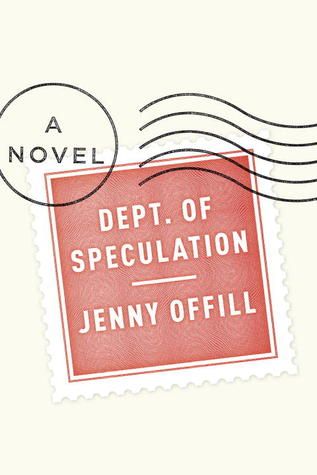
Review: Dept. of Speculation by Jenny Offill

Title: Dept. of Speculation
Author: Jenny Offill
Publisher: Knopf
Publication date: January 28, 2014
Rating: ★★★★★

Summary (via Goodreads):

Jenny Offill’s heroine, referred to in these pages as simply “the wife,” once exchanged love letters with her husband, postmarked Dept. of Speculation, their code name for all the uncertainty that inheres in life and in the strangely fluid confines of a long relationship. As they confront an array of common catastrophes – a colicky baby, bedbugs, a faltering marriage, stalled ambitions – the wife analyzes her predicament, invoking everything from Keats and Kafka to the thought experiments of the Stoics to the lessons of doomed Russian cosmonauts. She muses on the consuming, capacious experience of maternal love, and the near total destruction of the self that ensues from it, as she confronts the friction between domestic life and the seductions and demands of art.

I've been sitting here, staring at this blank screen, trying to figure out what it is I could possibly say about Jenny Offill's Dept. of Speculation. I think it's perhaps one of the best books I've read this year and definitely one of the most well-written. (Between the stories and quotes and trivia, it feels a bit like a Jeanette Winterson project, or Nicole Krauss' The History of Love, or Siobhan from the no-longer-maintained serialcomma.net.) (I started transcribing my favorite passages but thought I might be better off just investing in my own copy of the book because there were too many to list.)

Dept. of Speculation is about a lot of things. The slow descent into love. The process of finding someone you want to keep and who wants to stay with you too. How it sometimes feels like wading through water. It's about the gradual formation of a family and the life that comes with it and all the lives we give up. It's about the way our brains are wired, the way we make associations, the way we move from one thought to the next. It's about writing – the art and the science and the self-awareness, and how we sometimes have to trade our sanity and our happiness to create a thing of mad beauty.

This book is about the human condition. As you acquaint yourself with Jenny Offill's narrator, you think, "Christ, she is terrible, self-absorbed, judgmental, just awful," but meanwhile you're nodding in agreement. "I can't say I blame her. I would probably feel the same." It's the painful brutality of truth. She writes with such precision that if we were to say half the things she thinks, I think maybe we would all break into a million pieces, like sticking a pin into a fracture point.

And, anyway, maybe that's why you change your mind about her – you think, well, she's not so bad, because everything she says is spot-on. And suddenly it feels like we are justified in all our despicable, weak, human ways. Because she's insightful and she makes observations about the things we want, the things we need as human beings. Not just to survive – no, more than that. The things we need in order to feel fulfilled. To feel safe, intact, protected. The things that make us want to stay. She shows us all of these things in short, pithy statements, and you can't help but think to yourself, Yes, yes, that's right. And soon enough it doesn't matter so much that you did a horrible thing, or that he did things that left scars, because you realize we're all just struggling, trying to figure out how to exist in this fragile human state. (The book jacket is so very accurate. This universal shipwreck that unites us all, indeed.)

It's a terrible book to read if you're even a little bit cynical about love. Or if you're scared to fall in love. Or if you think love conquers all. It's terrible and frightening and exactly right, and it will make you rethink everything you know. Life is a series of gray lines that get grayer and grayer as time goes on.

There's an old expression: Things always look better in the morning. That's what this book feels like – like nothing is ever set in stone, like maybe life looks better once you've lived through it.

Thursday, July 24, 2014

Review: Graffiti Moon by Cath Crowley

Title: Graffiti Moon
Author: Cath Crowley
Publisher: Knopf Books for Young Readers
Publication date: February 14, 2012
Rating: ★★★★½

Summary (via Goodreads):

Lucy is in love with Shadow, a mysterious graffiti artist.

Ed thought he was in love with Lucy, until she broke his nose.

Dylan loves Daisy, but throwing eggs at her probably wasn't the best way to show it.

Jazz and Leo are slowly encircling each other.

An intense and exhilarating 24 hours in the lives of four teenagers on the verge: of adulthood, of HSC, of finding out just who they are, and who they want to be.

I. Loved. This. Book. Graffiti Moon was filled with all of the things I need/want/adore in literature: thoughtful, funny characters who are simultaneously weird and normal; luscious writing that doesn't go over the top; relationships between people who see the best in each other. Plus, graffiti and art talk! Bonus!

The style itself is reminiscent of Hilary T. Smith's Wild Awake – with its quirky characters who are utterly imperfect but fit so well together – as well as Melina Marchetta's Jellicoe Road, which is likewise filled with compelling relationships and reckless boys and all around flawlessness. I am obsessed with both of these books, so surely that will tell you something about my reaction to this one.

Graffiti Moon is split into three perspectives, which work especially well here. Each character has such a unique, interesting voice that the multiple perspectives feel welcome. First there is Lucy Dervish who, much like her name, is dreamy and lyrical. She has interesting hobbies (glassblowing and staring up at the stars until her life feels insignificant) and interesting goals (to find Shadow). Her thoughts on love and art are the kind of thoughts you want to seep into your brain and contemplate for days on end.

Next comes Ed Skye. Ed is pensive. He's romantic. He's a little bit lost. But there's something in him – not a spark, exactly, but something that resembles embers burning beneath the surface. He feels hopeless, but he's hopeful in spite of himself. Ed has a strong artistic voice that is balanced with pragmatism. His pages are enchanting to read because everything he says sounds significant.

I felt like I needed to run but my skin wouldn't let me. I had this urge to throw cans at the windows so I could hear a noise that sounded like escape.

Finally, there's Leo the poet. Leo's pages are few and far between, but they are powerful. His poems are short and sweet, and by sweet, I mean honest and spot-on and desperate and hopeful and sad. Lucy and Ed are ultimately the heart of the story, but Leo's poems shed some much-appreciated light on what's happening elsewhere. His words provide a richness, a depth, to the story as a whole.

Lucy and Ed's relationship unfolds through candid conversation, which we experience in what feels like real time. We learn about their shared history. We fall in love as they each hold their own in their verbal (and non-verbal, as you'll see below) sparring. There's very much an "I'll show you mine if you show me yours" mentality between Lucy and Ed. It's all the better knowing who Ed is and being able to watch everything slowly unravel. That, my friends, is the right way to accomplish the slow burn. 

I look over at Ed. He's staring out the window giving Leo the thumbs-down. I wait till he's looking at me, then I give him two fingers up. He gives me two fingers back. I give him the middle finger. He gives it back to me. I don't know any more signs, so I make up one. Three fingers. Take that, mister. He sticks up four. I call your four and raise you five. He skips straight to ten and does something with his thumb that disturbs me. I bounce my hands on my lap. Ed bounces his lap right back.

Cath Crowley is great about underscoring key themes. All throughout the book, the idea of "no guts, no glory" prevails. It starts with Lucy and her best friends Jazz and Daisy as they decide to go all-out on their last night of year 12. It extends to Ed and his assertiveness with his future, his assertiveness with the girls he loves... Circumstance is another concept that's well-explored in this book – whether it defines us, whether our choices matter, whether the outcomes of our lives are inevitable. There's a subtle strand of hope that makes its way through the story.

Art is also an important element in Graffiti Moon, and it is woven into the story in such a lovely, effortless way.  Both Ed and Lucy talk about graffiti and glassblowing so conceptually and thoughtfully that my inner art kid is swooning. They don't ever dumb down what art means, and in fact, they consider all these different ways to interpret and absorb it.

Most times I look at Shadow and Poet's work, I see something different from what the words are telling me. I like that about art, that what you see is sometimes more about who you are than what's on the wall. I look at this painting and think about how everyone has some secret inside, something sleeping like that yellow bird.

The writing in Graffiti Moon is simply brilliant. There are so many pages I love in their entirety. The book is a balance of the poetic and the everyday, the lush and the ordinary. That's what makes it all the more special – that there is beauty and art and poetry in the ugly and mundane. Cath Crowley's prose often stretches to the point of overwhelming, but then she manages to reign it all back in.

I do think the conflict with Malcolm Dove is a bit overblown and almost too conveniently resolved. It would have benefited from a more fleshed-out storyline. The ending also seems rushed, especially given that the rest of the book progresses at a more leisurely pace. However, Graffiti Moon remains beautifully written and, despite some minor shortcomings, still feels resolved. This book is ultimately about relationships – with the people you love and with yourself – and that's what comes through, in the end.